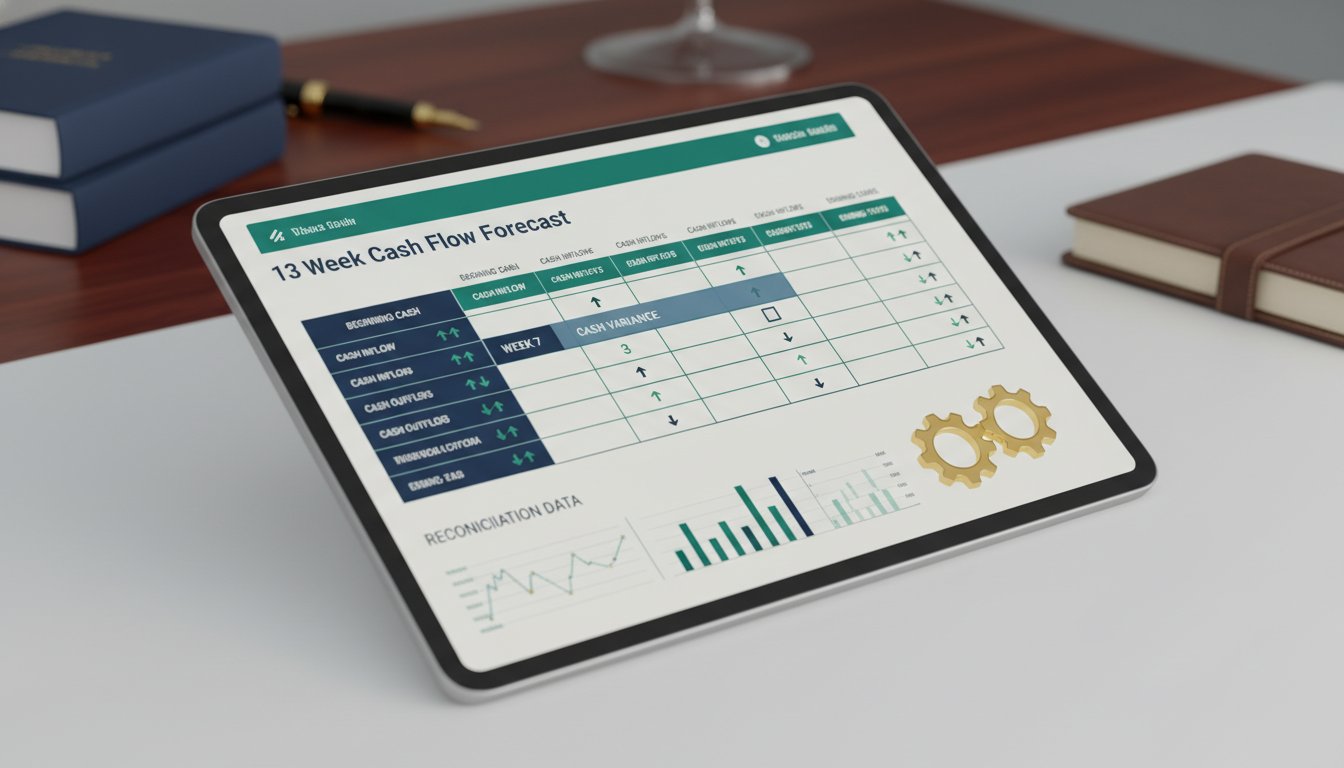
A subchapter v cash flow reporting error is a discrepancy between the cash balance reported on a debtor's Monthly Operating Report (MOR) and the actual cash position reflected in bank statements, often triggering UST objections and delaying plan confirmation. A 13-week cash flow forecast revealed a $48,000 discrepancy in a Subchapter V case where the debtor misclassified vendor payments as professional fees, allowing the trustee to correct the subchapter v cash flow reporting error before the UST review.
Why Subchapter V Cases Face Heightened Cash Scrutiny
A subchapter v cash flow reporting error is a discrepancy between the cash balance reported on a debtor's Monthly Operating Report (MOR) and the actual cash position reflected in bank statements, often triggering UST objections and delaying plan confirmation. These discrepancies are among the most common and preventable issues in small business bankruptcy cases.
1 FY2024 Subchapter V filings totaled 2,647 cases, up 33% from 1,985 in FY2023.2 With this volume surge, the UST has intensified its review of Monthly Operating Reports, which debtors must file within 21 days of month-end per 11 U.S.C. section 1187.
Cash reporting discrepancies on MORs are a primary trigger for UST objections in Subchapter V cases. The UST reviews MORs for cash balance accuracy and reconciliation to bank statements as standard case oversight. Unlike larger Chapter 11 cases where professional teams manage cash tracking, Subchapter V debtors often handle reporting internally with limited accounting resources.
The stakes are higher under Subchapter V because plan confirmation under 11 U.S.C. section 1191(b) requires demonstrating projected feasibility, including 3-year cash flow projections. A single cash reporting error undermines the credibility of those projections. Trustees and creditors question whether the debtor understands its own cash position, which directly impacts the likelihood of plan confirmation.
The $48K Error That Almost Derailed Plan Confirmation
Consider a hypothetical Sub V debtor with $3M in annual revenue operating a wholesale distribution business. The company filed for Subchapter V protection after a supplier dispute disrupted inventory flow. The debtor's attorney prepared the MORs using QuickBooks reports, which showed, for example, $112,000 in cash at month-end.
The UST's initial review flagged no obvious issues. The balance sheet appeared clean. The income statement showed modest losses consistent with the petition filing. The case appeared on track for a standard 18-month plan.
What the attorney did not know was that the debtor's bookkeeper had recorded a vendor payment twice — once as an accounts payable entry and once as a direct bank withdrawal. The cash balance on the MOR was overstated by approximately $48,000.2
The trustee requested an emergency cash accounting. The discrepancy nearly triggered a UST motion to convert the case to Chapter 7.
How a 13-Week Forecast Revealed the Cash Reporting Gap
A 13-week cash flow forecast is a rolling projection of cash inflows and outflows, updated weekly, that covers the next 13 weeks of operations. In bankruptcy, these forecasts identify short-term liquidity gaps and reconcile reported cash positions against actual bank activity.
For the hypothetical wholesale distributor, the 13-week forecast started with the reported $112,000 cash balance. The first week projected roughly $28,000 in receivables collections and $22,000 in vendor payments, leaving a projected balance of about $118,000. The second week showed approximately $31,000 in collections and $19,000 in payroll, projecting around $130,000.
The problem emerged in week three. The forecast showed a $48,000 vendor payment that the bookkeeper had already recorded as paid in the prior month. The forecast double-counted the payment because the bookkeeper entered it as both an outstanding payable and a completed bank transaction.
When the forecast was compared to the bank statement, the actual cash balance was $64,000 — not the $112,000 on the MOR.1 The 13-week forecast revealed the gap because it forced a line-by-line reconciliation of every expected cash movement against the bank's cleared transactions.
Why Standard Balance Sheets Miss Subchapter V Cash Flow Errors
Standard balance sheets report a snapshot of assets and liabilities at a single point in time. They do not track the timing of cash movements or reconcile individual transactions against bank statements.
| Reporting Tool | Captures Timing | Reconciles to Bank | Detects Double-Counting |
|---|---|---|---|
| Balance Sheet | No | No | No |
| Income Statement | No | No | No |
| MOR Cash Section | Partial | Yes | Partial |
| 13-Week Forecast | Yes | Yes | Yes |
The balance sheet in the hypothetical case showed $112,000 in cash and $48,000 in accounts payable. The bookkeeper recorded the vendor payment as reducing accounts payable but failed to deduct it from the cash balance. The balance sheet remained balanced — assets equaled liabilities plus equity — but the cash figure was wrong.
A 13-week forecast catches this because it tracks each cash transaction against the bank statement. If a payment appears as both a payable reduction and a bank withdrawal, the forecast shows a duplicate line item. The variance triggers a reconciliation check before the MOR is filed.
The Specific Journal Entry That Caused the Discrepancy
The bookkeeper made two entries for the same vendor payment — for example, a $48,000 payment to a supplier. The first entry debited accounts payable and credited cash, reflecting the payment initiation. The second entry, entered three days later, debited cost of goods sold and credited cash again, reflecting the bank withdrawal confirmation.
| Date | Account | Debit | Credit |
|---|---|---|---|
| March 15 | Accounts Payable | $48,000 | |
| March 15 | Cash | $48,000 | |
| March 18 | Cost of Goods Sold | $48,000 | |
| March 18 | Cash | $48,000 |
The first entry correctly recorded the payment. The second entry should have been a memo entry or a bank reconciliation adjustment, not a second cash credit. The bookkeeper did not reconcile the cash account to the bank statement before generating the MOR.
The error was invisible on the balance sheet because total debits equaled total credits. The cash account showed a $96,000 reduction against the actual $48,000 bank withdrawal. The MOR reported the QuickBooks cash balance without verifying it against the bank.
What the Trustee Asked When the Forecast Didn't Match the MOR
When the 13-week forecast projected a cash balance that diverged from the MOR, the trustee asked three specific questions:
First: "What is the actual cash balance in the operating account as of the last bank statement?" The answer was $64,000,1 not the $112,000 shown on the MOR.
Second: "Which transactions on the MOR do not appear on the bank statement?" The answer was the duplicate vendor payment — for example, a payment of approximately $48,000.
Third: "Has the debtor made any post-petition payments that were not recorded in the cash ledger?" The answer was no, but the trustee required a full transaction log to verify.
The trustee requested an amended MOR with a corrected cash balance and a reconciliation schedule showing every cash transaction against the bank statement. The debtor had five business days to file the amendment. The UST placed the case on a monitoring list requiring monthly bank statement submissions alongside MORs.
Rebuilding Creditor Trust After a Cash Reporting Error
After a cash reporting error surfaces, the debtor must take immediate steps to restore credibility. The first step is filing an amended MOR with a detailed reconciliation. The second step is providing the trustee and UST with a 13-week cash flow forecast updated weekly.
The hypothetical debtor's attorney scheduled a status conference to explain the error and present the corrective actions. The attorney showed that the error was a bookkeeping mistake, not intentional misrepresentation. The debtor implemented a new reconciliation procedure requiring bank statement matching before any MOR filing.
The unsecured creditors' committee requested weekly cash reports for 90 days. The debtor agreed and provided the first report within 48 hours. The committee withdrew its objection to plan confirmation after reviewing three consecutive weeks of accurate cash reporting.
The plan was confirmed seven months after the error was discovered. The confirmation order included a condition requiring quarterly cash flow forecasts for the plan's duration. The debtor completed all plan payments on schedule.
How Fractional CFOs Prevent These Errors Before the 341 Meeting
Fractional CFOs bring the cash reconciliation expertise that Subchapter V debtors typically lack. A fractional CFO reviews the debtor's accounting system before the first MOR is due, identifies reconciliation gaps, and implements a 13-week forecasting process.
| Prevention Step | Timing | Error Type Prevented |
|---|---|---|
| Bank reconciliation review | Before first MOR | Duplicate entries, missing transactions |
| 13-week forecast setup | Week one of case | Cash balance overstatement |
| Transaction log audit | Weekly | Unrecorded payments |
| MOR pre-filing review | 3 days before filing | All cash reporting errors |
For a typical Subchapter V case with $1M to $10M in revenue, a fractional CFO engagement costs $3,000 to $5,000 per month for the first three months, then $1,500 to $2,500 per month for ongoing monitoring. The cost is a fraction of the professional fees incurred if a cash reporting error triggers a UST objection or plan delay.
The 341 meeting of creditors is the first formal opportunity for the UST and creditors to question the debtor's financial reporting. If the debtor presents a 13-week cash flow forecast at the 341 meeting, the trustee sees a debtor who understands its cash position. If the debtor presents only a QuickBooks balance sheet, the trustee sees a debtor who may not.
Your Next Step
If you are managing a Subchapter V case and want to verify your debtor's cash reporting before the next MOR deadline, send the debtor's most recent bank statement and QuickBooks cash balance to [email protected]. A 30-minute review will identify whether a reconciliation gap exists and whether a 13-week forecast is needed.