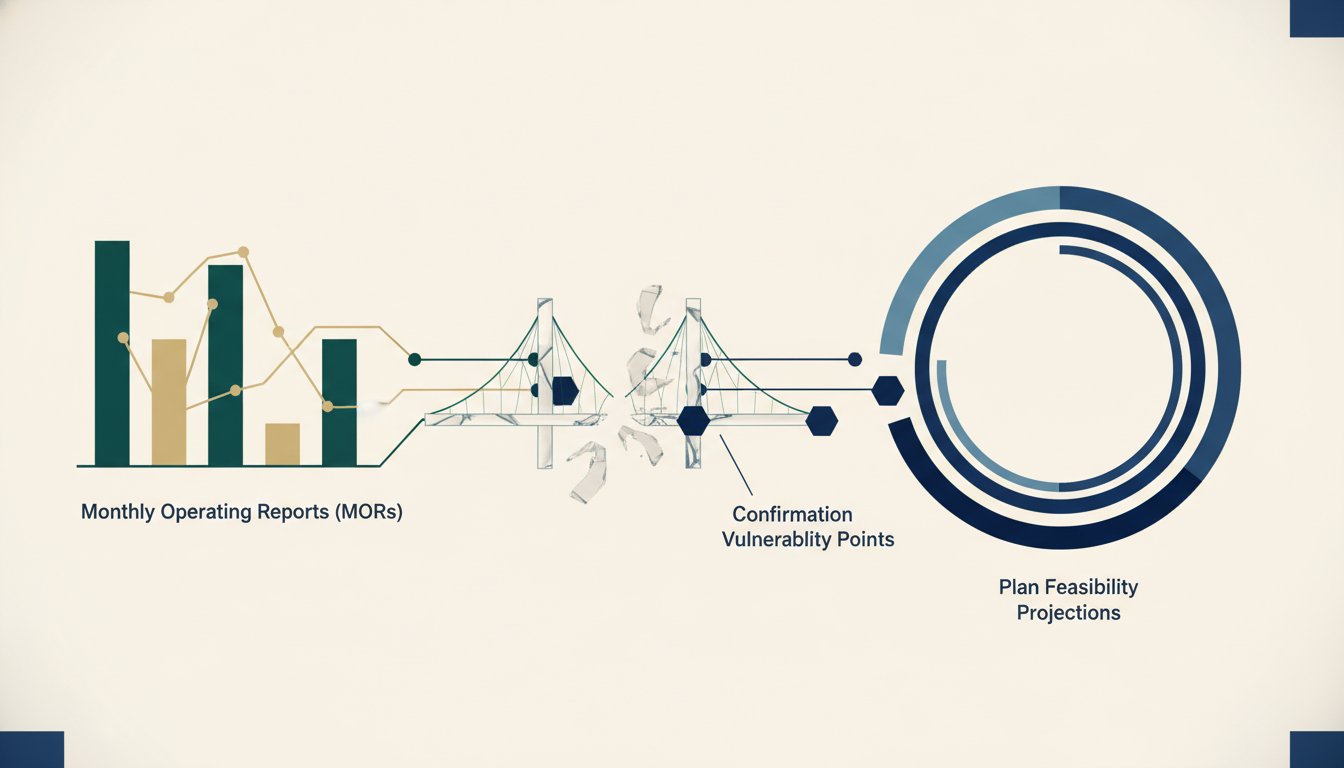
Where Consensual Plans Break Down in Subchapter V
Subchapter V consensual plan building errors occur when the financial bridge between a debtor's current operations and projected plan payments contains structural weaknesses that cannot withstand court scrutiny. These errors typically surface during confirmation when the UST or creditors identify gaps between Monthly Operating Report data and plan projections.
Consensual plan confirmation under Subchapter V requires acceptance by at least one impaired non-insider class under 11 U.S.C. § 1129(a)(10).1 The breakdown point is almost always the financial bridge — the documented path from current cash flow to the proposed payment stream.
The UST reviews 13-week cash flow projections for adequacy and flags projections that do not reflect realistic operations.2 When MOR exhibits show one set of numbers and the plan projection shows another, the court has no basis to find feasibility. The debtor must demonstrate that the financial bridge is supported by adequate documentation before confirming a consensual plan.3
Consider a hypothetical Sub V debtor with $3 million in annual revenue. The MOR shows average monthly net income of $15,000.4 Yet the plan proposes $25,000 monthly payments to creditors. Without a documented bridge explaining how operations will generate the additional $10,000 per month, the plan cannot be confirmed.
Why Leaky Financial Bridges Undermine Subchapter V Consensual Plans
The most common leak pattern involves revenue growth assumptions. A debtor's MOR shows flat or declining revenue for six months, then the plan assumes 15% growth starting in month one of the plan term — a hypothetical projection lacking operational support. The UST will object to feasibility because the projection lacks a documented basis.2
Another leak pattern involves expense reductions. Suppose the MOR shows $50,000 in monthly operating expenses, but the plan assumes $35,000 starting immediately. Without line-item documentation showing which expenses are being eliminated and how, the court cannot confirm the plan.
2 Courts increasingly require specific bridging documentation rather than general statements about future performance improvements.
The Three Most Common Cash Flow Reporting Errors in Sub V Cases
| Error Type | Description | Typical Consequence |
|---|---|---|
| Inflated revenue assumptions | Projecting revenue growth without documented basis in current operations | UST objection on feasibility grounds |
| Unsupported expense reductions | Cutting line items without identifying specific cost-saving measures | Court denial for lack of evidentiary support |
| Misclassified debt amortization | Treating priority or secured claims as general unsecured for payment purposes | Creditor objection and plan reclassification |
For example, a Subchapter V debtor with $2.5 million in debt might propose paying secured creditors over 60 months at 6% interest. If the MOR shows the debtor cannot cover current operating expenses, the court will question how the debtor can service additional debt payments.
How Inaccurate MOR Data Blocks Plan Confirmation
MOR data serves as the baseline for feasibility analysis. When the MOR contains errors or omissions, every projection built on that foundation becomes suspect.
The most common MOR errors affecting plan confirmation include revenue recognition timing, expense classification, and cash basis versus accrual basis inconsistencies.
Revenue recognition timing errors occur when recording prepetition receivables as post-petition revenue inflates operating performance. For instance, if a debtor reports $100,000 in monthly revenue on the MOR but $60,000 of that amount represents prepetition accounts receivable collected post-petition, the plan projection based on $100,000 in ongoing revenue will fail.1 The actual post-petition revenue is only $40,000.
Expense classification errors post professional fees to operating expenses instead of administrative claims, distorting true operating costs. Cash basis versus accrual basis switching between reporting periods without explanation creates irreconcilable data.
Building a 13-Week Cash Flow Model That Survives Trustee Scrutiny
A defensible 13-week cash flow model starts with actual MOR data and documents every assumption. The model should include beginning cash balance, projected receipts, projected disbursements, and plan payment obligations — each with source documentation and reconciliation to bank statements or vendor records.
| Component | Source | Documentation Required |
|---|---|---|
| Beginning cash balance | Most recent MOR | Bank statement reconciliation |
| Projected receipts | Accounts receivable aging + historical collection patterns | 12-month collection history |
| Projected disbursements | Accounts payable aging + operating expense history | Vendor payment terms |
| Plan payment obligations | Proposed plan terms | Amortization schedule |
The UST reviews 13-week cash flow projections for adequacy and flags projections that do not reflect realistic operations.2 Each assumption line should include a footnote referencing the source document. If the projection assumes a 45-day collection cycle, the model should reference the actual collection history from the preceding 12 months.
The Hidden Cost of Misclassified Revenue in Subchapter V Restructuring
Revenue classification errors create cascading problems in plan construction. When prepetition revenue is mixed with post-petition revenue, the debtor overstates operating performance and understates the true financial bridge needed.
Consider a retailer filing Subchapter V with $4 million in annual revenue. The MOR shows $350,000 in monthly revenue, but $120,000 represents prepetition gift card redemptions and customer deposits.1 The actual post-petition revenue is $230,000 per month.2 The plan projection based on $350,000 will fail because the bridge from $230,000 to the required payment level is unsupported.3
The fix requires segregating revenue streams on the MOR and in the plan projection. Prepetition collections should appear as a separate line item with clear labeling. The financial bridge should only use post-petition revenue as the baseline for projecting future performance.
Connecting Financial Reporting Gaps to Plan Feasibility Failures
Plan feasibility requires demonstrating the debtor can meet obligations through the plan term without further financial reorganization.1 Financial reporting gaps directly undermine this showing.
A typical gap pattern: the MOR shows $20,000 in monthly net income, but the plan proposes $15,000 in monthly payments to creditors — a scenario illustrating how inflated income figures create illusory feasibility. On its face, this appears feasible. However, the MOR includes $8,000 in non-recurring income from asset sales — proceeds from selling a company vehicle, for example. The true recurring net income is $12,000, making the $15,000 payment obligation impossible.
The UST will identify this gap during the confirmation review. The debtor must either restructure the plan to match actual recurring income or document a specific bridge showing how operations will generate the additional funds — $3,000 per month from a new service contract, for example.
Correcting Leaky Bridges Before Filing Your Plan Confirmation Motion
In my Chapter11 CFO practice handling Sub V cases, I have encountered this pattern repeatedly: a technically complete plan fails because the financial bridge lacks supporting documentation. Before filing the plan confirmation motion, conduct a systematic bridge audit.
Compare MOR data to plan projections line by line. Every variance over a material threshold — 10% or more — requires a documented explanation.
Verify revenue assumptions against 12-month history. If the plan assumes growth, document the specific operational changes that will produce it.
Confirm expense reductions are achievable. Each reduced line item should reference a specific action — lease renegotiation, vendor consolidation, staffing adjustment.
Test the 13-week cash flow model against actual bank statements. The model should reconcile to within a tight tolerance of actual cash position — for instance, 5%.
Subchapter V filings grew from 1,118 in FY2020 to 2,647 in FY2024, and the UST confirmed 614 cases through early 2025.4 Courts are increasingly scrutinizing financial bridges as case volume rises. A documented bridge with source-referenced assumptions survives confirmation review.
Your Next Step
Every variance over 10% needs a documented explanation before filing.2 Run this audit on your draft plan before the confirmation hearing. If you need a fresh perspective on the financial bridge, contact [email protected] or use the form at chapter11cfo.com.