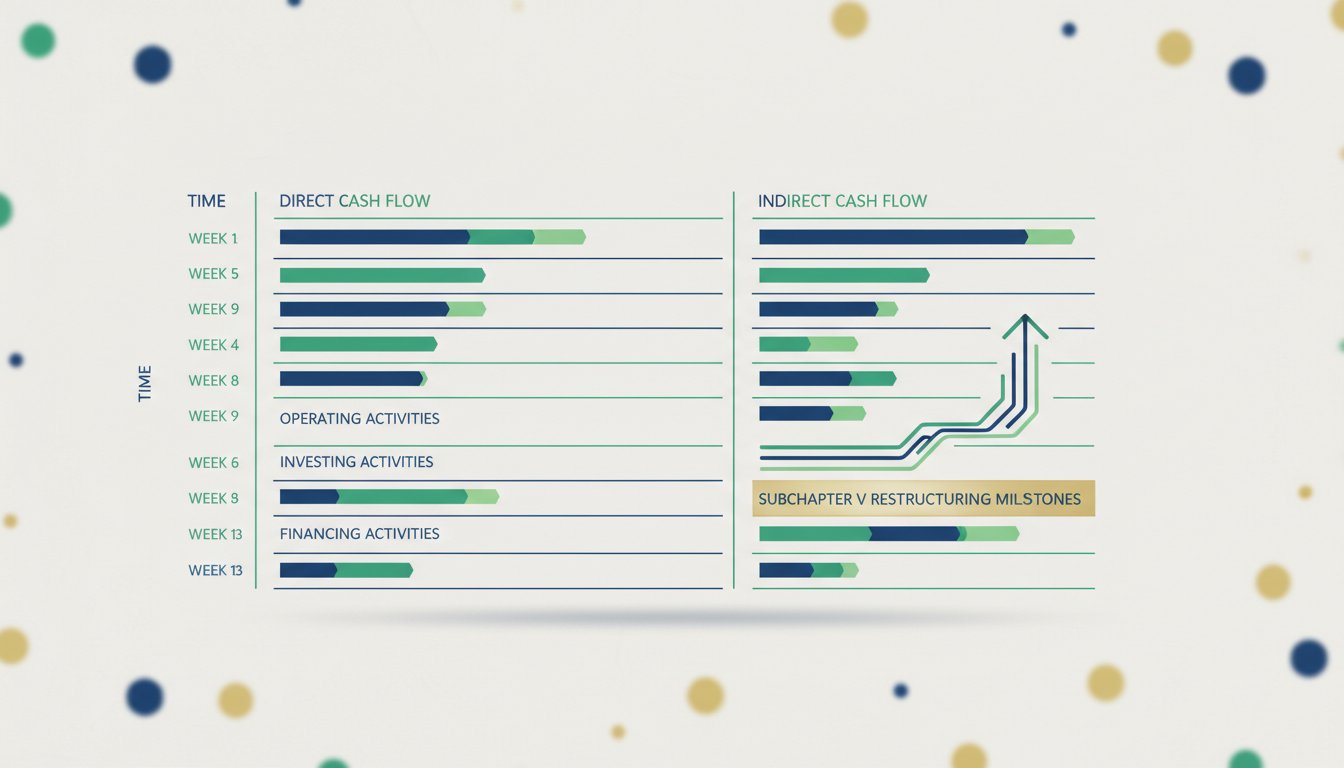
Direct vs Indirect Method for Subchapter V MORs
The 13-week cash flow direct method bankruptcy is a forecasting technique that lists every expected cash receipt and disbursement over a 13-week period, providing a granular, transaction-level view of a debtor's liquidity. This method is often required by the U.S. Trustee (UST) in Subchapter V cases to substantiate plan feasibility1. For bankruptcy attorneys, selecting the wrong cash flow reporting method can trigger unnecessary objections, delay plan confirmation, and undermine the debtor's credibility with the court.
The choice between direct and indirect cash flow methods for Monthly Operating Reports (MORs) and 13-week forecasts is not merely an accounting preference—it is a strategic decision that impacts case administration. The direct method reports actual cash transactions: receipts from customers, payments to suppliers, payroll, and loan payments. In contrast, the indirect method begins with net income and adjusts for non-cash items like depreciation and changes in working capital accounts such as accounts receivable and payable2.
For Subchapter V debtors, whose noncontingent liquidated secured debts cannot exceed $7.5 million3, the indirect method's reliance on accrual-based net income introduces opacity. A debtor could show a net profit on paper while experiencing a critical cash shortfall, a disconnect that the UST scrutinizes closely. The direct method eliminates this by forcing a reconciliation of the bank account itself, which is the ultimate measure of a debtor's ability to fund a plan.
| Aspect | Direct Method | Indirect Method |
|---|---|---|
| Starting Point | Opening cash balance | Net income/loss |
| Primary Focus | Cash receipts & disbursements | Reconciliation of net income to cash |
| Transparency | High; shows source/use of every dollar | Low; masks timing of cash flows |
| UST Preference | Strongly preferred for 13-week forecasts1 | Often questioned for feasibility analysis |
| Ease of Preparation | More labor-intensive, requires detailed data | Easier, derived from P&L and balance sheet |
| Best For | Demonstrating precise weekly liquidity | Explaining profitability vs. cash flow differences |
The Direct Method: A 13-Week Cash Flow Blueprint for Subchapter V
A court-ready 13-week cash flow forecast using the direct method functions as a week-by-week operational blueprint. It moves beyond high-level summaries to answer specific questions: When will the major customer payment hit the bank? On which Friday is the quarterly tax payment due? How does the payroll cycle align with incoming receivables?
Constructing this blueprint requires categorizing every cash movement. Major categories typically include operating receipts (broken down by customer or revenue stream), cost of goods sold payments, selling, general & administrative expenses (SG&A), payroll and taxes, debt service, and professional fees. For a Subchapter V debtor, this granularity is not optional; it is the evidence required under 11 U.S.C. § 1191(b) to convince the court and creditors that the debtor can make plan payments as they come due1.
Consider a hypothetical wholesale distributor with $3 million in annual revenue entering Subchapter V. A direct method forecast would not simply state "weekly purchases." It would detail the cash outlay to specific key vendors, the timing of those payments based on negotiated terms, and the anticipated cash inflow from major retail customers, often showing the lag between shipment and payment. This operational detail is what transforms a financial statement into a management tool and a credible court document.
Why the UST and Creditors Demand Direct Method Projections
The UST's mandate includes monitoring the debtor's performance and opposing plans that are not feasible. A direct method cash flow projection is the primary tool for this assessment because it tests liquidity—the ability to pay bills as they become due. The indirect method, starting with net income, can be misleading. Depreciation add-backs and changes in working capital assumptions can create a projected cash balance that is not tethered to actual cash collection and payment cycles.
For example, a debtor's forecast might show adding back $20,000 in monthly depreciation. However, that non-cash expense does not put money in the bank to pay next week's payroll. Similarly, an indirect forecast might assume a reduction in accounts receivable will generate cash, but if those receivables are from a financially troubled customer, the collection timeline may be unrealistic. The UST will object to such unsupported assumptions. The direct method forces the debtor to justify each line item based on contractual payment terms and realistic collection probabilities, which provides the transparency the UST requires to approve a plan.
Creditors, especially trade vendors and secured lenders, apply the same scrutiny. They need to see exactly when and how they will be paid. A direct method forecast that clearly shows the source of funds for their specific payment—for instance, identifying that a $50,000 payment to a secured lender in Week 9 is funded by a collection from a major account in Week 8—builds essential confidence in the plan's viability.
Indirect Method Pitfalls That Can Derail Your Sub V Plan
Relying on an indirect method cash flow forecast for a Subchapter V plan feasibility analysis introduces several critical risks that can lead to UST objections and plan rejection.
1. Opaque Working Capital Assumptions: The indirect method buries critical assumptions about accounts receivable collection and accounts payable deferral within net working capital changes. A forecast might optimistically project collecting 80% of receivables within 30 days, but if the debtor's historical collection period is 60 days, the resulting cash inflow projection is flawed. The UST will challenge these embedded assumptions, often requiring a full breakout that essentially reconstructs the direct method.
2. Misalignment with Weekly Cash Reality: The 13-week forecast is a weekly tool, but net income is a monthly or quarterly metric. Translating a monthly net income figure into a weekly cash flow requires arbitrary allocations that may not match actual cash timing. A business might be profitable in a month but have a severe cash crunch in the second week due to a bi-weekly payroll and a large inventory payment. The indirect method can completely miss this timing mismatch.
3. Inability to Identify Specific Cash Shortfalls: When a shortfall appears in an indirect forecast, it is difficult to diagnose the operational cause. Is it a delayed customer payment? An unplanned equipment repair? The indirect method does not provide the line-item detail needed to quickly implement a corrective action, such as calling a customer for payment or negotiating terms with a supplier. This lack of diagnostic power undermines the debtor's ability to manage the case and respond to UST inquiries.
Converting Your Client's Accounting to a Direct Cash Flow Model
Transitioning a client from indirect to direct cash flow reporting is a methodological shift that requires accessing transaction-level data. The process typically involves the following steps:
- Aggregate Cash Transaction Data: Compile 3-6 months of bank statements and detailed general ledger records. Every deposit and check must be categorized.
- Establish Cash Flow Categories: Create a chart of accounts for the cash flow statement. Common categories include: Cash Receipts from Customers, Loan Proceeds, Owner Contributions; and Cash Disbursements for Inventory/Purchases, Payroll, Rent, Utilities, Loan Payments, and Professional Fees.
- Forecast Based on Drivers: For each category, identify the business driver. Customer receipts are driven by sales invoices and collection terms. Payroll is driven by headcount and pay schedules. This creates a model where changes in operational assumptions automatically update the cash forecast.
- Reconcile to Bank Balance: The forecast must start with the actual bank balance as of the petition date and prove forward each week. The final projected balance must be realistic and sufficient to cover a buffer for unexpected expenses.
For a service business with, for instance, $1.5 million in revenue, the model would focus on projecting cash receipts from its top 10-15 clients based on their payment history and contract terms, rather than a blanket percentage of monthly sales. This client-specific approach is what gives the direct method its credibility.
Essential Line Items for a Court-Ready 13-Week Forecast
A Subchapter V 13-week cash flow forecast must be both comprehensive and intelligible to the court. The following line items are considered essential for demonstrating operational control and feasibility:
| Section | Essential Line Items | Why It's Required |
|---|---|---|
| Cash Receipts | • Collections from Accounts Receivable• Cash Sales• Loan Funding (DIP/Exit)• Tax Refunds | Shows all sources of liquidity. Breaking out A/R collections from cash sales highlights collection risk. |
| Cash Disbursements | • Payroll & Related Taxes• Payments to Critical Vendors• Rent/Lease Payments• Utilities & Insurance• Debt Service (Pre-petition & Post-petition)• Professional Fees (Segregated pre-petition vs. post-petition) | Demonstrates ability to meet ongoing obligations. Segregating professional fees per Official Form 425C is critical to avoid UST objections4. |
| Financing Activities | • DIP Loan Draws/Repayments• Capital Injections from Owners | Discloses all external funding supporting the plan. |
| Key Metrics | • Ending Cash Balance• Weekly Cash Change• Cumulative Cash Flow | Provides a quick snapshot of liquidity trend and minimum cash position. |
Omitting any of these core disbursements, such as segregating professional fees, is a common trigger for UST comments. The forecast must also include a clear assumption section explaining the basis for key projections, like the collection rate for receivables or the timing of a tax refund.
How Direct Method Reporting Strengthens Your Plan of Reorganization
The direct cash flow method does more than satisfy procedural checkboxes; it actively strengthens the legal and strategic position of the Plan of Reorganization. By providing undeniable clarity on liquidity, it turns the cash flow statement from a defensive document into an affirmative tool for plan confirmation.
First, it directly addresses the "feasibility" standard under 11 U.S.C. § 1191(b)1. The court must find that confirmation is not likely to be followed by liquidation or further financial reorganization. A direct method forecast that shows, week by week, that cash inflows from operations are sufficient to cover all operational costs and structured plan payments provides the concrete evidence needed for this finding. It shifts the argument from theoretical profitability to demonstrable solvency.
Second, it facilitates more productive negotiations with creditors and the creditors' committee. When a secured lender can see the specific weekly cash accumulation that leads to their payment, they are more likely to accept the timeline. When a vendors' committee can see that all critical trade payments are maintained to ensure supply, they are more likely to support the plan. Transparency built on the direct method reduces uncertainty, which is the primary driver of creditor objections.
Integrating the 13-Week Cash Flow into Your MOR Submissions
The 13-week cash flow forecast is not a standalone document; it must be fully integrated with the debtor's Monthly Operating Reports (MORs). The UST compares the forecast submitted with the plan against the actual results reported in each subsequent MOR. Significant variances require immediate explanation.
The integration works as a feedback loop. Week 1-4 actuals provide the first month's MOR with actual cash results for the first four weeks of the forecast. Variance analysis requires the debtor or financial advisor to analyze any material variance between projected and actual cash flows—for example, if customer receipts were 15% below forecast, the cause must be identified. The 13-week forecast should be updated rolling forward, incorporating actual results from the first month and refining assumptions for remaining weeks. This updated forecast should be available for the UST or creditors upon request. The cash activity reported on the MOR's Statement of Cash Receipts and Disbursements must align with categories and methodology used in the direct method forecast. Inconsistency between the two documents is a red flag that can lead to allegations of poor financial controls.
This integrated process demonstrates to the court that the debtor is not only projecting viability but also actively monitoring and managing its performance against that plan—a key indicator of a successful reorganization.
Your Next Step
Review the most recent 13-week cash flow forecast you received for a Subchapter V case. Check if it uses the direct method by looking for a line-item listing of specific cash receipts and disbursements, or if it begins with net income and adjusts for depreciation. If it is the latter, you have identified a material risk to plan confirmation that requires addressing before submission to the UST. For a template and guidance on converting to a court-ready direct method model, send the case details to [email protected].
Footnotes
-
11 U.S.C. § 1191(b) - Plan Feasibility in Subchapter V Cases. https://www.law.cornell.edu/uscode/text/11/1191 ↩ ↩2 ↩3 ↩4
-
American Institute of CPAs (AICPA), Statement of Cash Flows (Topic 230). https://www.aicpa-cima.com/resources/landing/statement-of-cash-flows ↩
-
11 U.S.C. § 1187(c) - Debt Limit for a Small Business Debtor in Subchapter V. https://www.law.cornell.edu/uscode/text/11/1182 ↩
-
Official Form 425C (Revised 2023) - Monthly Operating Report for Small Business Debtor Under Subchapter V of Chapter 11. https://www.uscourts.gov/forms/small-business-debtor/monthly-operating-report-small-business-debtor-under-subchapter-v-chapter-11 ↩ ↩2 ↩3