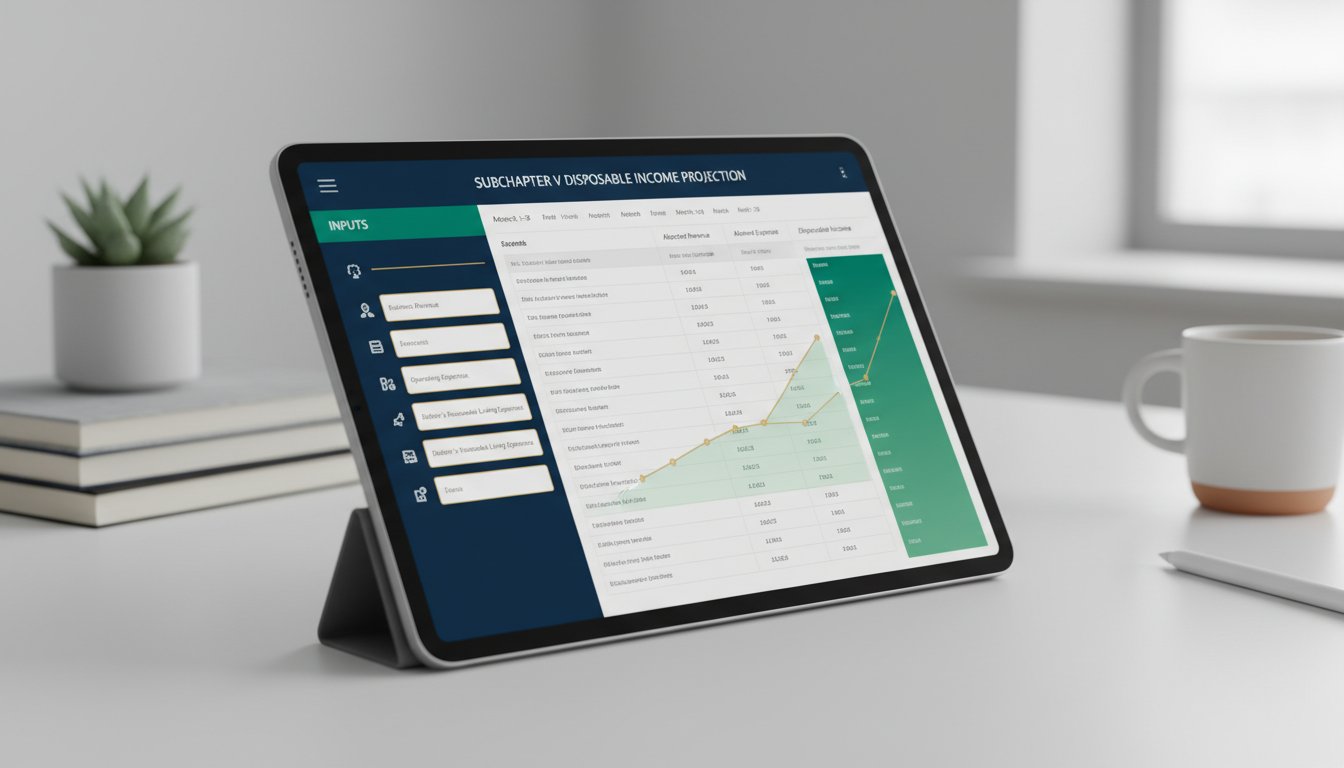
Understanding the Disposable Income Test Statutory Framework Under § 1191(c)(2)
The disposable income test subchapter v requires a debtor to commit all projected disposable income for a period of three to five years to payments under the plan of reorganization1. A flawed projection is a primary cause of plan rejection, making a robust financial model critical for confirmation.
The legal foundation is 11 U.S.C. § 1191(c)(2). This statute mandates that a plan cannot be confirmed unless it provides that all of the debtor's projected disposable income to be received during the applicable commitment period will be applied to make payments under the plan2. The commitment period is three years, but the court may extend it to five years3. This requirement applies specifically to individual debtors, as cross-referenced by § 1129(a)(14)4.
This framework creates a forward-looking obligation distinct from the historical "means test" used in Chapter 7 or 13. The test is prospective, requiring a credible forecast of financial performance.
The statute explicitly excludes from the disposable income calculation any amounts "reasonably necessary to be expended" for the continuation, preservation, or operation of the debtor's business5. This exclusion is the core of the modeling challenge: defining what expenses are "reasonably necessary" for reorganization versus what constitutes disposable income available for creditors.
The growth in Subchapter V filings underscores the test's practical importance. UST filings in these cases grew from 1,118 in FY 2020 to 2,647 in FY 20246, indicating increased scrutiny. A model must withstand this scrutiny by directly linking its assumptions to the statutory language of § 1191(c)(2).
| Expense Category | Typical Scrutiny Level | Key Justification Required |
|---|---|---|
| Core Payroll (Key Employees) | Low | Role is essential for current operations; compensation is market-rate. |
| Rent & Utilities | Low | Lease is necessary for business location; costs are consistent with market. |
| Debtor-in-Possession Financing Costs | Medium | Terms are necessary and reasonable; lender approval is documented. |
| New Hire Salaries | High | Direct link to a revenue-generating activity in the plan; hiring timeline is specified. |
| Marketing / Business Development | High | Campaign is targeted; expected return is quantified; budget is phased. |
| Owner/CEO Compensation | Very High | Compensation is reasonable for services rendered; often compared to pre-petition levels. |
What the Disposable Income Test Actually Measures in Subchapter V
Projected disposable income is not merely a forecast of net profit. It is a calculation of the cash flow available for plan payments after accounting for expenses deemed necessary for the business's reorganization.
The model must start with projected revenue and subtract three categories: (1) cost of goods sold, (2) operating expenses that are "reasonably necessary," and (3) allowed capital expenditures. The remainder is the projected disposable income.
The UST and creditors will challenge any expense that appears excessive, discretionary, or not directly tied to the reorganization effort. For example, a marketing budget for a new product line may be scrutinized if the business's confirmed plan is based on servicing existing contracts. The model must justify each line item.
The legal precedent is clear: as seen in In re Double H Transportation, confirmation can be denied when the "debtor failed to introduce credible evidence supporting its projected disposable income"7.
A practical model distinguishes between survival expenses and growth expenses. Survival expenses are those required to maintain current revenue streams and are generally defensible. Growth expenses, which aim to increase future revenue, require detailed justification tied to specific, achievable milestones in the plan.
How to Build a 13-Week Cash Flow Model for the Test
The foundation of a credible multi-year projection is a detailed 13-week cash flow model. This short-term forecast bridges the historical data from the Monthly Operating Reports (MORs) to the long-term plan.
MORs, required under 11 U.S.C. § 1187, must be filed within 21 days after the end of each month8 and provide the actual financial data that validates or invalidates the model's starting assumptions.
Begin by populating the first four weeks with the most recent actual results from the MORs. This grounds the model in reality. For the subsequent nine weeks, project cash inflows based on a detailed accounts receivable aging schedule and a conservative estimate of new sales. Project cash outflows using a vendor-by-vendor analysis, prioritizing critical trade payables, payroll, taxes, and administrative expenses of the estate.
The 13-week model serves two critical functions for the disposable income test. First, it demonstrates the debtor's ability to manage liquidity through the early stages of the case, a key concern for the UST.
Second, it establishes the baseline revenue and expense run-rate from which the 3-year projection is extrapolated. If the 13-week model shows consistent cash generation, it supports the assumption that the business can produce disposable income. If it shows continual cash shortfalls, the long-term projection will be viewed as unrealistic.
Projecting Future Income: Realistic Assumptions vs. Trustee Scrutiny
Extending the 13-week baseline into a 3-year projection requires assumptions that are both optimistic enough to show feasibility and conservative enough to be credible. The UST will reject generic, unsupported assumptions.
A projection stating "market recovery will lead to 10% growth" invites an objection. A defensible assumption must be specific, document-based, and tied to identifiable business actions.
For instance, a defensible revenue assumption for a hypothetical manufacturer might be: "Revenue is projected to increase by 8% in Year 2, based on the addition of two new account managers hired in Month 6, as outlined in the sales hiring plan (Exhibit B)." This links a financial outcome to a operational decision documented in the plan.
Consider a hypothetical Sub V debtor with $3 million in revenue. A generic 5% annual growth projection is weak. A stronger model would segment revenue by specific drivers.
For example: "A 3% price increase is modeled for Year 3, reflecting contractual escalation clauses in 70% of active service agreements with major clients A, B, and C, per attached contract excerpts." Another robust approach is to model diversification: "The model reduces reliance on Top Customer A from 40% to 25% over 3 years by allocating $60,000 to targeted marketing, with initiatives detailed in the sales plan (Exhibit C)."
| Assumption Type | Weak, Objectionable Example | Defensible, Detailed Example |
|---|---|---|
| Revenue Growth | "We expect 5% market growth." | "Growth of 6% in Year 2 is supported by the renewed 3-year contract with Client X, which represents 30% of revenue, as documented in Exhibit B." |
| Expense Reduction | "We will cut overhead by 15%." | "SG&A expenses will decrease by $120,000 annually post-petition, achieved by terminating the lease for Warehouse B (redundant after consolidation) and eliminating one non-essential administrative position." |
| Capital Expenditures | "$200,000 for new equipment." | "$75,000 allocated in Year 1 for the mandatory replacement of Press #3, per attached mechanic's report citing imminent failure. No other CapEx is planned." |
Calculating Reasonably Necessary Business Expenses for the Test
The phrase "reasonably necessary" from § 1191(c)(2)(B) is the battleground for the disposable income calculation. The model must proactively justify every significant expense line.
Start with fixed costs like rent, utilities, and core payroll for employees critical to daily operations. These are usually non-controversial if they align with pre-petition levels and industry norms.
Variable and discretionary expenses require rigorous justification. For a discretionary item like a trade show budget, the model must directly tie it to a projected pipeline or customer retention metric.
For example, a model could state: "A $24,000 annual trade show budget is included, as historical data shows 40% of new leads originate from this event9, directly supporting the Year 2 revenue projection."
Owner or shareholder compensation is intensely scrutinized. A $200,000 salary for the CEO of a struggling company with $2 million in revenue is a clear objection target. The model must benchmark compensation against industry standards for companies of similar size and financial condition. Post-filing, the UST may challenge whether any increase or even the full pre-petition amount is "reasonably necessary" if the business's goal is cost reduction to maximize creditor payments.
Professional fees must be accurately classified. The model should segregate pre-petition fees (often subject to disallowance) from post-petition fees (administrative expenses). Blending these can distort the projected disposable income.
Common Modeling Errors That Trigger UST Objections
Several recurring flaws in disposable income models lead to objections and plan rejection.
First is the use of over-optimistic, "hockey-stick" revenue projections without underlying contractual or operational support. The court in Double H Transportation specifically rejected a plan due to a lack of credible evidence10.
Second is the failure to properly classify and justify capital expenditures. Treating a desirable equipment upgrade as a necessary expense will be challenged. Each CapEx line must be supported by evidence of necessity, such as a maintenance report or regulatory requirement.
Third is omitting or understating required debt service. The model must account for payments on secured debt that is being reinstated or repaid under the plan, as these are contractual obligations.
Fourth is the inclusion of expenses for expansion or new initiatives that are not integral to the core reorganization strategy. If the plan's feasibility hinges on maintaining existing customer relationships, a large budget for entering a new geographic market may be deemed not "reasonably necessary."
Fifth, and most technical, is a misalignment between the MOR data and the model's starting point. If the MORs show declining revenue, but the model's projection begins with an immediate increase, the discrepancy must be explicitly explained with a triggering event, like the approval of a critical contract.
Integrating the Test Model with Your Plan of Reorganization
The disposable income model is not a standalone document; it is the financial engine of the plan of reorganization. The model's output—the annual projected disposable income—directly determines the total pool of funds available for plan payments.
Under § 1191(b), a plan can be confirmed without impaired class acceptance if it meets the requirements of § 1129(a)11, which includes the disposable income test.
The model must align with the plan's treatment of creditor classes. For example, if the model shows projected disposable income of $1.2 million over three years, and unsecured claims total $2 million, the plan cannot propose a 70% payout to unsecured creditors without identifying another source of funds, such as a third-party contribution or asset sale. The math must be internally consistent.
Furthermore, the plan should incorporate a "disposable income kicker" or "true-up" provision. This clause obligates the debtor to pay a percentage (often 50-100%) of any actual disposable income that exceeds the projected amount in the model to the trustee for the benefit of creditors. This mechanism addresses the inherent uncertainty in projections and provides creditors with upside potential, which can facilitate acceptance.
Presenting the Financial Model to the Court and Creditors
Clarity and transparency are paramount when presenting the model. The core projection should be summarized in a simple table within the plan disclosure statement. A detailed, line-item backup model should be prepared as an exhibit, ready for review by the UST and creditors.
| Projected Disposable Income Calculation | Year 1 | Year 2 | Year 3 | Total |
|---|---|---|---|---|
| Total Revenue | $3,500,000 | $3,600,000 | $3,700,000 | $10,800,000 |
| Less: Reasonably Necessary Expenses | ($3,100,000) | ($3,150,000) | ($3,200,000) | ($9,450,000) |
| Projected Disposable Income | $400,000 | $450,000 | $500,000 | $1,350,000 |
| Cumulative for Plan Payments | $1,350,000 |
Every material assumption behind the numbers in this summary must be documented in an accompanying narrative. Reference the supporting evidence: "Year 2 revenue increase ties to Contract Y renewal (see Exhibit D)." "Year 3 salary increase reflects union contract escalation (see Exhibit E)."
During the confirmation hearing, be prepared to walk the court through the logic of the model, emphasizing its conservative grounding and direct link to the business's reorganization strategy.
Your Next Step
Review the most recent Monthly Operating Report for your Subchapter V debtor. Map its actual revenue and expense lines directly into the first month of a 13-week cash flow forecast.
This exercise will immediately highlight where your client's current performance aligns with or diverges from a sustainable run-rate, providing the factual foundation required to build a defensible 3-year disposable income projection. For a template and detailed guidance on structuring this model, contact [email protected].
Footnotes
-
11 U.S.C. § 1191(c)(2) - Projected Disposable Income Commitment, https://www.law.cornell.edu/uscode/text/11/1191 ↩
-
11 U.S.C. § 1191(c)(2)(A), https://www.law.cornell.edu/uscode/text/11/1191 ↩
-
11 U.S.C. § 1191(c)(2), https://www.law.cornell.edu/uscode/text/11/1191 ↩
-
11 U.S.C. § 1129(a)(14), https://www.law.cornell.edu/uscode/text/11/1129 ↩
-
11 U.S.C. § 1191(c)(2)(B), https://www.law.cornell.edu/uscode/text/11/1191 ↩
-
Executive Office for U.S. Trustees, Quarterly Statistical Summary, FY 2020-2024, https://www.justice.gov/ust/file/statistics_2024.zip/download ↩
-
In re Double H Transportation, LLC, No. 21-10242 (Bankr. D. Del. Jan. 12, 2022), https://casetext.com/case/in-re-double-h-transp-llc-1 ↩
-
11 U.S.C. § 1187 - Monthly Operating Report, https://www.law.cornell.edu/uscode/text/11/1187 ↩
-
https://www.nfib.com/content/marketing-research/state-of-small-business/ ↩
-
In re Double H Transportation, LLC, No. 21-10242 (Bankr. D. Del. Jan. 12, 2022), https://casetext.com/case/in-re-double-h-transp-llc-1 ↩
-
11 U.S.C. § 1191(b), https://www.law.cornell.edu/uscode/text/11/1191 ↩
-
11 U.S.C. § 1191(c)(2), https://www.law.cornell.edu/uscode/text/11/1191 ↩