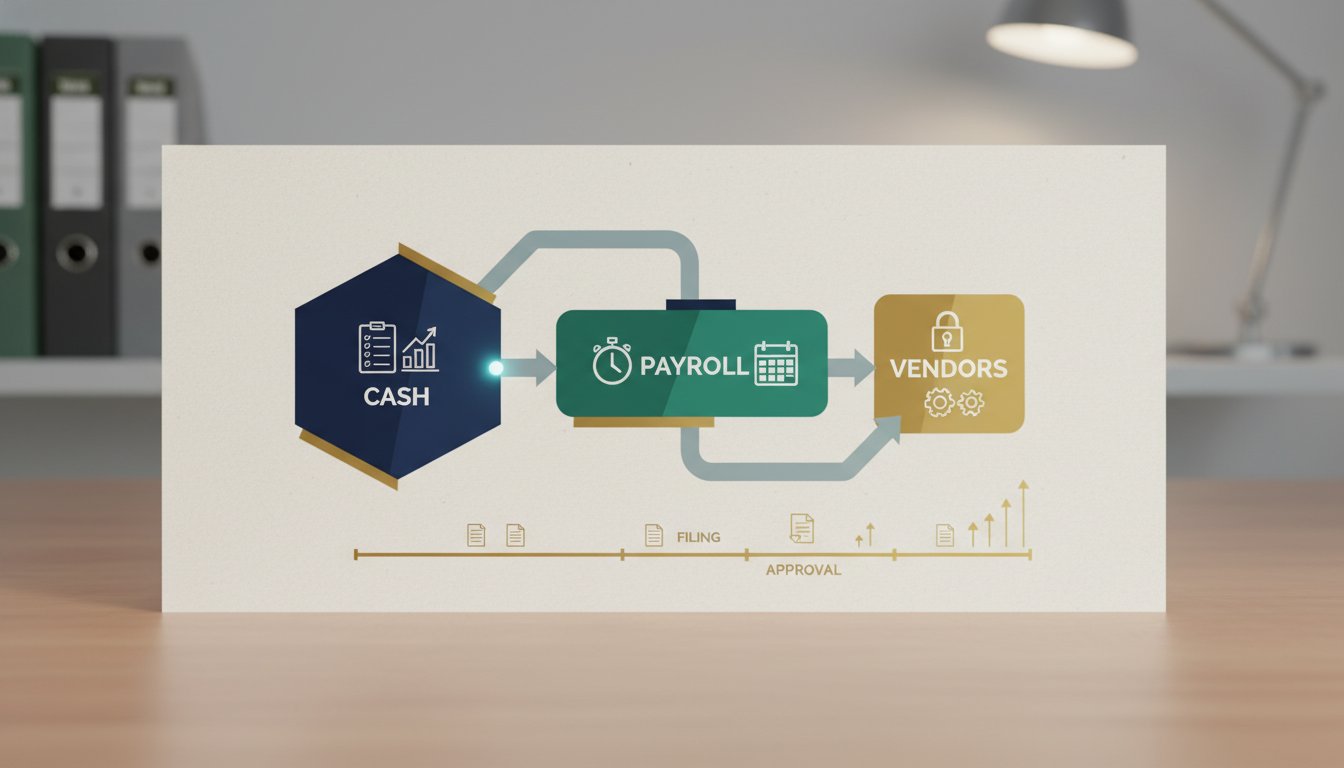
Chapter 11 first day motions cash collateral is a statutory mechanism under 11 U.S.C. § 363(c)(2) that prohibits a debtor from using a secured creditor's cash without consent or court authorization. This mechanism, combined with the payroll motion and critical vendor motion, forms the operational tripod that keeps a small business running post-filing. A Subchapter V case lives or dies in its first three days, and the cash collateral budget is the single most scrutinized exhibit in the first day hearing.1
Drafting the Cash Collateral Motion with Adequate Protections
A Subchapter V case lives or dies in its first three days. The cash collateral motion, the payroll motion, and the critical vendor motion form the operational tripod that keeps a small business running post-filing. Chapter 11 first day motions cash collateral is the statutory mechanism under 11 U.S.C. § 363(c)(2) that prohibits a debtor from using a secured creditor's cash without consent or court authorization, making the accompanying budget the single most scrutinized exhibit in the first day hearing.1
The cash collateral motion must demonstrate that the debtor can operate without diminishing the secured creditor's position. Adequate protection typically takes one of three forms: replacement liens on post-petition assets, periodic cash payments equal to depreciation, or a superpriority administrative expense claim under 11 U.S.C. § 507(b).1
For a Subchapter V debtor with $3M in annual revenue (a typical mid-sized small business), the cash collateral budget should break down projected receipts and disbursements by week for at least the first 30 days. The UST expects to see line items for payroll, rent, utilities, inventory purchases, and professional fees. A common error is lumping "operating expenses" into a single line — courts routinely reject budgets that lack line-item specificity.
The motion should also include a proposed order that caps the debtor's use of cash collateral at a specific dollar amount, typically 80% of projected collections for the first 30 days. Any variance above that threshold requires a supplemental filing or emergency hearing.
Why First Day Motions Set the Subchapter V Case Trajectory
First day motions signal to the court, the UST, and creditors whether the debtor has a realistic path to confirmation. A well-prepared set of motions suggests the debtor's management and counsel understand the financial discipline required under Subchapter V.
The median Subchapter V case duration is 8-14 months with a confirmed plan, compared to Chapter 11's 2-5 year timeline.2 That compressed schedule means the first day motions must be right the first time. A cash collateral budget that projects unrealistic revenue growth or omits seasonal fluctuations will trigger UST objections that delay the entire case.
Consider a hypothetical retailer filing Subchapter V in October. If the cash collateral budget fails to account for holiday inventory purchases, the debtor will run out of cash by December and face dismissal or conversion. The first day motions are the court's first look at whether the debtor's management has a realistic grasp of their own numbers.
Cash Collateral Orders: What the Court Needs to See
A cash collateral order must contain five elements to pass judicial scrutiny: (1) the amount and source of cash collateral, (2) the budget for its use, (3) the adequate protection being provided, (4) reporting requirements, and (5) a carve-out for professional fees.1
| Element | What the Court Expects | Common Deficiency |
|---|---|---|
| Amount and source | Bank statements, AR aging, deposit records | No reconciliation of pre-petition balances |
| Budget | 13-week cash flow by week, by line item | Single "operating expenses" line |
| Adequate protection | Replacement lien or periodic payment | Vague description of collateral |
| Reporting | Weekly cash reports to secured lender | No deadline or format specified |
| Professional fee carve-out | Specific dollar cap, typically $25,000-$50,000 | No carve-out at all |
The order should also include a "budget variance" provision that allows the debtor to reallocate up to a typical 10% between line items without seeking further court approval. This flexibility prevents the debtor from returning to court for minor adjustments while maintaining the overall cap.
The Critical Vendor Motion: Strategy and Justification
Critical vendor motions require demonstrating that the vendor is essential to operations and that payment is necessary to prevent irreparable harm, with many courts requiring 100% payment of pre-petition claims.3 The motion must identify each vendor by name, the amount owed, and why that vendor is irreplaceable.
For a small business debtor, the critical vendor list typically includes the primary raw material supplier, the sole distributor of a proprietary product, and the utility provider that cannot be switched. A typical Subchapter V debtor might seek approval to pay 5-10 critical vendors totaling $50,000-$150,000 in pre-petition claims.
The justification section should include a brief explanation of why each vendor is unique. For example, a specialty food manufacturer might need to pay its sole organic ingredient supplier because switching vendors would require FDA re-labeling and a 90-day lead time. The court wants to see that the debtor has actually shopped alternatives, not simply assumed the vendor is critical.
Payroll as a First Day Priority: Avoiding Administrative Claims
Prepetition wages up to $15,150 per employee qualify for priority treatment under 11 U.S.C. § 507(a)(4), and the first day payroll motion typically seeks authority to pay these amounts immediately.4 The motion must include a schedule of employees, their prepetition wage claims, and the total amount sought.
The risk of delaying the payroll motion is that employees who are not paid within the first week post-filing will leave for other jobs. For a small business with 10-20 employees, losing two key staff members can halt operations entirely. The payroll motion should also cover accrued vacation time and commissions earned pre-petition, as these are often overlooked.
A well-drafted payroll motion includes a certification from the debtor's CFO or controller that the amounts sought are accurate and that no employee received preferential payments in the 90 days before filing. The UST will check this certification against the debtor's payroll records during the first MOR review.
Building the 13-Week Cash Flow for First Day Hearings
DIP financing and cash collateral orders must include 13-week cash flow projections demonstrating ability to repay postpetition debt.5 The projection should start with actual cash on hand at filing, then show weekly receipts, disbursements, and ending cash balances. For example:
| Week | Beginning Cash | Receipts | Disbursements | Ending Cash |
|---|---|---|---|---|
| 1 | $50,000 | $75,000 | $90,000 | $35,000 |
| 2 | $35,000 | $80,000 | $85,000 | $30,000 |
| 3 | $30,000 | $85,000 | $80,000 | $35,000 |
| 4 | $35,000 | $90,000 | $85,000 | $40,000 |
The assumptions underlying the projection must be stated explicitly. For a hypothetical Subchapter V debtor, the projection might assume that 70% of accounts receivable are collected within 30 days and that gross margins remain at 35%. If the debtor's historical collection rate is, for example, 60%, the projection using 70% will be flagged by the UST.
The 13-week cash flow should also include a sensitivity analysis showing the impact of a revenue decline and an expense increase — for example, a 10% drop in revenue combined with a 10% rise in expenses. Courts appreciate seeing that the debtor has stress-tested their own projections.
Common First Day Motion Pitfalls in Small Business Cases
The most frequent objection to first day motions in Subchapter V cases is an inadequate cash collateral budget. UST objections to inadequate cash collateral budgets increased significantly in 2023-2024.6 The typical deficiency is a budget that projects revenue growth without explaining the source of that growth.
Another common pitfall is failing to include the secured creditor's consent or objection timeline in the motion. Under 11 U.S.C. § 363(c)(2), the debtor must provide notice to the secured creditor and allow time for a response before the hearing.1 If the motion is filed on a Thursday for a Monday hearing, the creditor may not have adequate time to review the budget.
Critical vendor motions often fail because the debtor cannot produce balance sheet verification for the amounts owed. The court expects to see invoices, purchase orders, or delivery receipts for each critical vendor claim. A motion that simply lists amounts without supporting documentation will be denied or continued.
Coordinating with the UST on Cash Collateral Budgets
Subchapter V trustees review all first day motions and MORs for compliance, and the UST's office has become increasingly aggressive in objecting to budgets that lack detail.6 The debtor's counsel should send the proposed cash collateral budget to the UST at least 48 hours before the first day hearing.
The UST will look for three things in the budget: (1) are the revenue projections consistent with historical performance, (2) are the expense categories reasonable for the debtor's industry, and (3) does the budget include adequate reserves for professional fees. For example, if the debtor's historical revenue was $250,000 per month but the budget projects $400,000, the UST will demand an explanation.
A practical approach is to include a "worst case" scenario in the budget that shows the debtor can survive a significant revenue shortfall — for example, a 20% drop in monthly sales. This demonstrates that the debtor has considered downside risk and is not relying on overly optimistic assumptions.
Your Next Step
Review your current first day motion template against the five-element cash collateral order checklist in this post. If your template lacks a budget variance provision or a professional fee carve-out, update it before your next Subchapter V filing. For a practitioner-ready cash collateral budget template and 13-week cash flow model calibrated for small business debtors, email [email protected].
Footnotes
-
https://www.law.cornell.edu/uscode/text/11/363 ↩ ↩2 ↩3 ↩4 ↩5
-
https://www.uscourts.gov/sites/default/files/data_files/statistics/Length%20of%20Time%20in%20Bankruptcy_0.pdf ↩
-
https://www.govinfo.gov/content/pkg/USCODE-2022-title11/pdf/USCODE-2022-title11-chap9-sec364.pdf ↩
-
https://bn-lawyers.com/navigating-the-crucial-initial-days-of-a-chapter-11-filing-first-day-motions/ ↩
-
https://www.uscourts.gov/sites/default/files/data_files/statistics/Bankruptcy%20Filings%202024_0.pdf ↩ ↩2