The Moment You Realize You Got It Wrong
The most dangerous mistake I have made as a Subchapter V fractional CFO this year was one I nearly put into a signed Monthly Operating Report. The client, a mid-size commercial HVAC contractor in Texas, had filed Subchapter V earlier in the year. By late March I was deep into finalizing what was going to be the debtor's second full MOR. The arithmetic on the financials was done. The Balance Sheet tied. The P&L tied. The Bank Reconciliation (built exactly to the Form 425C book-basis specification I wrote about in the last post in this series) tied to the penny.1 All that remained was the yes-or-no questionnaire at the back of Form 425C — the eighteen questions numbered Q1 through Q18 that most practitioners rush through in the last thirty minutes before submission because they feel like a formality.
And Question 3 is the one where I almost made the wrong filing decision. Q3 reads, in its official wording: "Have you paid all of your bills on time?" The format invites a Yes or No answer and requires an attached explanation ("Exhibit A") if the answer is No. Every practitioner I have ever worked with treats this question the same way — they open the AP Aging Summary, scan the 31–60, 61–90, and 90+ buckets, and if anything sits in those buckets, they default to No. I had done exactly that. I had opened the February AP Aging for this client, spotted that a commercial auto insurance balance of roughly $5,247 had aged out of the 1–30 day bucket and into the 31–60 day bucket during the reporting month, and drafted Exhibit A language explaining the progression. I wrote something along these lines: "Certain pre-petition obligations remain in the Debtor's accounts payable aging as they are being addressed through the Plan of Reorganization. Subsequent cash receipts were applied to cure post-petition balances as they became due."
I sent that draft to my CPA partner for review. Four hours later the response came back: "This is not what the question is asking. Strip the pre-petition reference out." That was the moment I realized I had misunderstood the scope of MOR Question 3 for three months of practice. Not just in a small way. In the way that, if the UST analyst on the case happened to be reading closely, might prompt a follow-up inquiry about why the debtor appeared to be commingling pre-petition and post-petition obligations in its own compliance reporting.
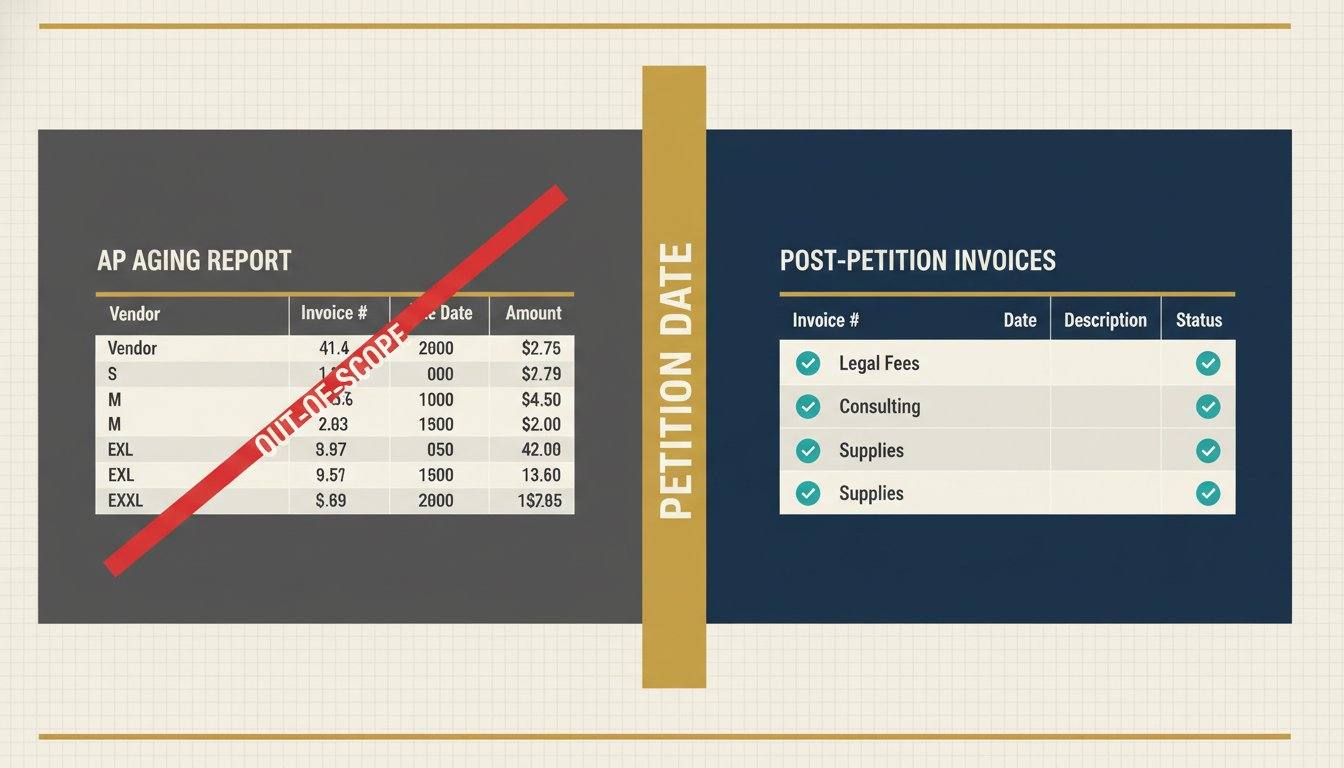
The bug in my thinking was simple and, in retrospect, obvious. I had been treating the AP Aging Summary as an authoritative answer source for Question 3. It is not. The AP Aging is a bookkeeping artifact that shows every unpaid payable in the general ledger — regardless of whether the underlying obligation is legally payable on its original terms under the automatic stay. Question 3, by contrast, is a compliance question specifically about the debtor's performance on post-petition obligations. The two populations only partially overlap. The AP Aging includes pre-petition debts that are legally stayed from payment. Question 3 excludes those same debts from its scope entirely. If you answer Question 3 from the AP Aging without first sorting the pre-petition from the post-petition debts, you are answering a different question than the one the UST asked.
What follows is the reasoning, the decision flow, and the Exhibit A template I wish I had written down eighteen months earlier. This is not a subtle point. It is a core scoping rule that every Subchapter V debtor and every fractional CFO serving them should have baked into their MOR checklist before their first filing. But the rule is nowhere stated in plain language on the face of Form 425C, and it is only implied in the official UST Debtor Guidelines. The result is that — from what I can see, talking with other restructuring professionals about their small-case practices — a substantial fraction of the MOR filings in this country are answering Question 3 the wrong way.
What Form 425C Question 3 Actually Asks
The precise wording of Question 3 in the Form 425C questionnaire (Part 7) is short: "Have you paid all of your bills on time?" Followed by a "Yes / No" radio button, followed by a conditional: "If no, attach Exhibit A listing bills that were not paid timely and an explanation for why not."2
Three things to notice in the literal text.
First, the word "bills" is undefined on the face of the form. A naïve reading maps "bills" to "every invoice in the accounts payable ledger." That is not the reading the UST applies, and it is not the reading the underlying statutory framework supports. The meaning of "bills" in this context is constrained by the UST Chapter 11 operating report framework, which distinguishes rigorously between pre-petition and post-petition obligations. We will get to the specific language in the next section.
Second, the phrase "on time" is also undefined. Does it mean "within the vendor's original due date," "within a 30-day typical business tolerance," "before the invoice enters the 31+ aging bucket," or "before the bankruptcy court says it has to be paid"? The answer, again, flows from the underlying statutory framework. For post-petition obligations the standard is "as they become due" — meaning on the vendor's original contractual due date, not on any extended tolerance. For pre-petition obligations, "on time" is a legally meaningless concept, because the debtor is legally forbidden from paying them on their original terms at all.
Third, the Exhibit A trigger. If the answer is No, the filer must attach a list of the specific bills that were not paid timely, with an explanation. The word "list" is important. The UST wants specifics — vendor name, invoice amount, age of the balance — not a general narrative. And "explanation" means the debtor has to attribute the delay to a cause the UST finds reasonable. Timing differences on a post-petition invoice (e.g., vendor emailed an invoice on the 25th, due on the 10th of the following month, debtor cut a check on the 12th because of an internal approval cycle) are acceptable explanations. Non-payment on pre-petition obligations is not an acceptable "explanation" at all — because those balances are outside the scope of the question.
So the question, unpacked in compliance terms, is really: "For each post-petition obligation that came due during the reporting period, did you pay it on or before its contractual due date?"
That is a far narrower question than "are any of your payables in an aging bucket past 30 days?" And once you scope the question that tightly, the decision flow becomes clean.
Why Post-Petition Only: The 11 USC § 362 Automatic Stay
The reason Question 3 is scoped to post-petition obligations only is not a matter of UST preference. It is a direct consequence of the automatic stay imposed by 11 U.S.C. § 362(a) at the moment a bankruptcy petition is filed.
Section 362(a) is one of the shortest and most consequential provisions of the Bankruptcy Code. Among other things, it states that the filing of a petition operates as a stay, applicable to all entities, of: "any act to collect, assess, or recover a claim against the debtor that arose before the commencement of the case under this title" (11 U.S.C. § 362(a)(6)) and "the commencement or continuation . . . of a judicial, administrative, or other action or proceeding against the debtor that was or could have been commenced before the commencement of the case under this title . . ." (11 U.S.C. § 362(a)(1)).3
Read those two clauses together. The moment the petition is filed, every pre-petition creditor is legally prohibited from taking any action to collect their pre-petition claim. Symmetrically — and this is the part most practitioners miss when they think about the stay — the debtor is also legally restricted from paying those pre-petition claims on their original contractual terms outside of court-approved process. That restriction does not flow from § 362 alone (which, by its plain text, stays creditor actions). It flows from the combination of the DIP's fiduciary duties under § 1107, the ordinary-course limitation under § 1108, and § 549's provision making unauthorized post-petition transfers avoidable by the trustee. A debtor who writes a check to a pre-petition creditor outside of the court-approved process (typically the confirmed plan of reorganization, or in some cases a first-day motion approval for critical vendors) is committing an unauthorized post-petition transfer under § 549, which can be avoided by the trustee and which, more importantly, is a direct indicator of fiduciary mismanagement of the estate.
This is why Chapter 11 practice imposes a rigorous cutoff at the petition date. Every obligation gets categorized as one of two species: pre-petition or post-petition. Pre-petition obligations are "stayed" — frozen in place — until the Plan of Reorganization (or the Subchapter V equivalent) specifies how they will be treated. Some will be paid in full. Some will be paid partially. Some will be discharged. The debtor cannot pay any of them on their original contractual terms without court authorization, because doing so would be preferential to that creditor and would violate the automatic stay's symmetry.
Post-petition obligations, by contrast, are governed by a different rule entirely. Under 11 U.S.C. § 503(b)(1)(A), post-petition operating obligations qualify as administrative expenses of the estate — "the actual, necessary costs and expenses of preserving the estate." The UST Debtor Guidelines then impose the operational timing obligation: these administrative expenses must be paid as they become due in the ordinary course of business. The UST Debtor Guidelines state this rule in the clearest possible terms. The U.S. Department of Justice's Office of the United States Trustee, Region 13, publishes a document titled "Local Requirements and Debtor Guidelines" that every debtor in the region receives at case commencement. The relevant sentence reads: "the debtor must pay all obligations arising after the filing of the petition ('post-petition') in full when due."4 The sentence is not hedged. It is a flat affirmative obligation. Post-petition bills must be paid in full, on time, on their original contractual due date.
Now combine the two rules. Pre-petition debts: legally prohibited from payment on original terms. Post-petition debts: affirmatively required to be paid in full when due. Question 3 asks whether the debtor has met its payment obligations. The only payment obligations the debtor has during the pendency of the case (absent a confirmed plan) are the post-petition ones. The pre-petition debts do not generate a Question 3 issue no matter how long they sit in the AP Aging, because the debtor is not supposed to be paying them in the first place.
That is the underlying logic of Question 3's scope. It is not a scope the UST invented to make the question narrower — it is the only scope that is internally consistent with the Bankruptcy Code's treatment of debts during the pendency of a Chapter 11 case.
There are two important corollaries to this scoping rule that come up repeatedly in small-case practice.
Corollary 1: Pre-petition AP Aging is irrelevant to Question 3 regardless of aging bucket. A pre-petition debt can sit in the 1–30 bucket in January, age into the 31–60 bucket in February, age into the 61–90 bucket in March, and so on. That aging progression does not create a Question 3 issue. The debt is frozen in legal time at the petition date, and its progression through aging buckets is a bookkeeping artifact with no compliance significance. The fact that a pre-petition vendor's invoice is now 120 days past its original due date is expected — that is how the automatic stay is supposed to work. The AP Aging report will continue to show these balances aging out until the Plan of Reorganization discharges or restructures them, and that is perfectly consistent with compliant Chapter 11 operation.
Corollary 2: A post-petition timing issue is the only Question 3 trigger. The only way to generate a Question 3 = No answer is if a post-petition obligation was not paid on its original contractual due date during the reporting period. That can happen for innocuous reasons (a vendor emailed the invoice late, the debtor's approval cycle ran over the weekend, the cash receipt from a customer arrived one day after the vendor's due date) or for more serious reasons (the debtor actually did not have the cash to pay). In either case, the answer is No, and Exhibit A must explain the specific post-petition invoice, the days of delay, and the cause.
I want to restate Corollary 2 once more because it is where most of the practitioner confusion clusters. Even if a post-petition obligation is currently sitting at zero-days-overdue at month-end — meaning every post-petition invoice has either been paid on time or is not yet due — the Question 3 answer may still be No if, during the reporting period, a post-petition invoice was paid after its due date. Question 3 asks about performance during the period, not status at month-end. If an invoice came due on the 17th of the month and was paid on the 19th (two days late), that generates a Question 3 issue even if the AP Aging at month-end shows no overdue post-petition balances. Practitioners who answer Question 3 purely from the month-end AP Aging position sometimes under-report Question 3 issues for this reason.
With the scoping rule clear, the decision flow writes itself.
The Anatomy of the Mistake I Nearly Made
Let me walk through the specific error I made with the HVAC contractor case, because the pattern is instructive. The debtor's AP Aging Summary for February 28, 2026 (the reporting period for the MOR I was preparing) showed a commercial auto insurance carrier with a balance of $5,247.33 in the 31–60 day bucket. Backtracking to the January 31 AP Aging, that same carrier had shown roughly $8,924.10 in the 1–30 day bucket, and partial payments in early February had reduced the balance while also allowing the remaining balance to age out into the 31–60 bucket.
My first pass analysis went like this. "The carrier's balance is aging out. It progressed from 1–30 in January to 31–60 in February. That means the debtor did not pay it on time. Question 3 should be No, with an Exhibit A explaining that some pre-petition obligations are being addressed through the Plan of Reorganization." I wrote the draft Exhibit A along those lines and sent it for review.
My CPA partner replied with the one-line correction that reset my understanding. He wrote (paraphrased): "The auto carrier's balance is pre-petition. It is stayed. Question 3 doesn't care about it. You are confusing yourself by looking at the AP Aging before you split pre-petition from post-petition." He attached the DOJ Region 13 guidelines and highlighted the "post-petition in full when due" sentence.
The first thing I did after reading his reply was open the debtor's petition schedules and the vendor's invoice history. The commercial auto policy had been issued in October 2025 — pre-petition. The policy had been cancelled by the carrier after the filing (a common post-petition creditor action, though often technically a stay violation if not done through the proper motion; in small cases the debtor rarely pushes back). The $5,247.33 balance in the February AP Aging was the unpaid pre-petition premium. It was frozen at the petition date in legal terms. Its progression through the aging buckets in January, February, and March was the bookkeeping system simply updating the aging days on a frozen balance.
In other words: the AP Aging report was telling me the truth about when the balance was recorded, but it was telling me nothing at all about whether Question 3 should be answered Yes or No. Once I stripped the pre-petition items out of the analysis, I was looking at a much smaller set of balances. The actual post-petition AP consisted of a handful of vendors:
- An equipment rental company for temporary HVAC testing equipment, balance $3,892.45, invoice dated February 14 with a Net 30 due date of March 16. At February month-end, the invoice was not yet due, so no Question 3 issue.
- A software subscription provider for the debtor's dispatch platform, balance $1,489.75, auto-charged on the first of the month. Paid on February 1. No Question 3 issue.
- A city utility bill (natural gas), balance $872.20, due February 23, paid February 22. No Question 3 issue.
- A parts supplier, balance $2,156.80, invoice dated February 3 with a Net 30 due date of March 5. Not yet due at February month-end. No Question 3 issue.
- A fuel card account, balance $1,104.60, typical monthly billing, paid on due date. No Question 3 issue.
And here is the key moment. Walking through the post-petition population this way, the correct Question 3 answer for this debtor for the February reporting period turned out to be Yes. Every post-petition obligation that had a due date in February had been paid on or before its due date. The pre-petition auto carrier balance that had initially led me to answer No was irrelevant to the scope of the question.
The final MOR for this debtor was filed with Q3 = Yes, no Exhibit A attached, clean. If I had submitted the draft I first wrote, the MOR would have had a No answer and an Exhibit A that mixed pre-petition and post-petition language inappropriately. It would not have been fraudulent, but it would have been incompetent — a signal to any UST analyst reading carefully that the debtor's CFO did not fully understand the scope of the question.
The takeaway for my own practice was simple. I had to build a pre-petition/post-petition split into the MOR preparation workflow, not as an afterthought but as the first step of Question 3 analysis. The decision flow below reflects the protocol I now use.
The Correct Q3 Decision Flow
There are exactly five steps. Every Subchapter V and small Chapter 11 MOR I now prepare runs Question 3 through this sequence before the answer gets locked in.
Step 1. Open the AP Aging Summary for the reporting period's month-end date.
Pull the report directly from the accounting system (QuickBooks Online, Xero, or wherever the debtor's AP lives). Export to Excel or a PDF. This is the raw data, not the answer.
Step 2. Tag every line as pre-petition or post-petition.
For each vendor balance on the aging report, determine whether the underlying obligation arose before or after the petition date. The mechanics of this tagging vary by system. In QuickBooks Online, you can open each vendor's transaction history and look at the invoice dates. Any invoice dated on or before the petition date is pre-petition. Any invoice dated after the petition date is post-petition.
Edge cases to watch for. A continuing service contract (e.g., a monthly software subscription) where one invoice fell pre-petition and subsequent invoices fell post-petition must be split: the pre-petition invoice is stayed, the post-petition invoices are administrative expense obligations payable in full when due. A single vendor may appear twice in the pre/post split.
For a vendor with a single pre-petition invoice that remains unpaid (like the auto carrier in my worked example), the tagging is trivial — the entire balance is pre-petition.
In practice, I tag the AP Aging in a working Excel file by adding a column labeled "Petition Side" and entering "PRE" or "POST" for each line. This working file is useful later as backup documentation for the UST analyst.
Step 3. Set aside everything tagged PRE.
Pre-petition balances are out of scope for Question 3. They will be addressed through the Plan of Reorganization and are frozen by the automatic stay in the meantime. They have no Question 3 significance and should not appear in the Exhibit A if one is required.
(If the Plan has not yet been confirmed and the pre-petition balances are still sitting on the AP Aging, that is normal. The AP Aging is a bookkeeping system and has no automatic-stay awareness. The pre-petition balances will continue to appear and continue to age out until the Plan discharges or restructures them.)
Step 4. Examine only the POST-tagged population. For each line, answer two sub-questions:
Sub-question 4a: Was this invoice's contractual due date during the reporting period?
- If the due date was in a future period (after the reporting period's month-end), the invoice is not yet due and it is irrelevant to Question 3 for this reporting period. (It will be examined next month.)
- If the due date was in a prior period, then it was examined in a prior MOR and should already have a Question 3 answer in the prior filing.
- If the due date was during the current reporting period, proceed to Sub-question 4b.
Sub-question 4b: Was this invoice paid on or before its contractual due date?
- Yes: no Question 3 issue for this line.
- No: Question 3 issue for this line. Record the details (vendor, invoice date, due date, amount, date paid if paid, or "unpaid as of month-end" if still outstanding).
Step 5. Aggregate the Step 4 results.
- Zero Question 3 issues: Answer Yes. No Exhibit A required.
- One or more Question 3 issues: Answer No. Exhibit A is required and must list each post-petition invoice with a vendor name, invoice amount, original due date, date paid (or "unpaid"), and a plain-English explanation of the cause of the delay.
This is the entire decision flow. In my practice, a reporting period with fewer than ten post-petition vendors with activity in the period takes about fifteen minutes to run through this flow end-to-end once the accounting data is ready. A larger case (hundreds of post-petition vendors) takes longer but the Pre/Post tagging is the only step that scales with vendor count — the Sub-question 4a/4b logic is fast per line.
Notice what this flow does not ask. It does not ask what the aging bucket is. It does not ask how long any balance has been outstanding. It does not ask whether the AP Aging "looks bad" or has balances past 30 days. All of those instincts that practitioners carry in from the world of non-bankruptcy credit management are distractions in the Chapter 11 context. The only thing Question 3 cares about is whether each post-petition obligation was paid on or before its contractual due date during the reporting period. Everything else is noise.
The $5,247 Example From a Recent Engagement
Here is the anonymized worked example from the HVAC contractor case, showing the full decision flow applied to a real month.
Setup.
- Debtor: a mid-size commercial HVAC contractor, single-member LLC, Texas-based, approximately $380,000 in monthly revenue, 8 full-time employees.
- Case filed: earlier in 2026, Subchapter V.
- Reporting period: the month immediately preceding the one I was preparing in.
- MOR due: the 21st of the following month, per the local UST deadline.
- I prepared the MOR in the closing days of the month and signed it at month-end.
Step 1: AP Aging pull.
February 28, 2026 AP Aging Summary from QuickBooks Online showed thirteen vendors with outstanding balances totaling $24,471.53. Bucket distribution:
| Aging Bucket | Total | Number of Vendors |
|---|---|---|
| Current (0–30 days) | $14,789.30 | 9 |
| 31–60 days | $5,247.33 | 1 |
| 61–90 days | $3,117.50 | 2 |
| 90+ days | $1,317.40 | 1 |
| Total | $24,471.53 | 13 |
On first read, the 31–60 and 61–90 buckets (totaling $8,364.83) looked like Question 3 issues. The 90+ bucket especially felt like a flag. This is where the pre-scoping reflex would have produced a No answer.
Step 2: Pre/Post tagging.
I walked through each of the thirteen vendors using the vendor history in QuickBooks Online and tagged each balance as PRE or POST. Here is the resulting split.
| Vendor Category | PRE | POST |
|---|---|---|
| Commercial auto insurance carrier (policy from October 2025) | $5,247.33 | |
| Commercial general liability carrier (policy from November 2025) | $3,117.50 | |
| Parts supplier (pre-petition invoice from December 2025) | $1,317.40 | |
| Equipment rental company (February invoice) | $3,892.45 | |
| Dispatch software subscription (February monthly charge, paid Feb 1) | ||
| City utility — natural gas (February, paid Feb 22) | ||
| Parts supplier (post-petition February invoice) | $2,156.80 | |
| Fuel card account (February, paid on due date) | ||
| Subcontractor labor (February work, invoice dated Feb 20) | $4,278.00 | |
| Advertising — local trade directory (February, paid Feb 10) | ||
| Truck lease (February, paid Feb 5) | ||
| IT support contractor (February, paid Feb 15) | ||
| Bookkeeper fee (February, paid Feb 28) | ||
| Totals | $9,682.23 | $10,327.25 |
(Paid post-petition invoices do not appear in the month-end aging because they are already paid — they are in the "paid" section of the vendor ledger. The totals above include three partial-month balances and several paid-in-period vendors who had activity during the period but zero balance at month-end.)
Step 3: Set aside the PRE.
The $9,682.23 of pre-petition balances (the auto carrier, the general liability carrier, and the pre-petition parts supplier invoice) drop out of the Question 3 analysis. These are stayed under § 362(a)(6) and will be addressed through the Plan. They will keep aging out in future reports until discharged or restructured. They have no Question 3 significance.
This is where I had originally gone wrong in my first draft — I was treating the auto carrier's aging-out pattern as a Question 3 flag. It was not. The moment I tagged it as PRE, it left the analysis entirely.
Step 4: Post-petition analysis.
For each POST vendor, the Sub-question 4a / 4b logic applied.
-
Equipment rental company, $3,892.45. Invoice dated February 14, 2026. Net 30 terms, due date March 16. Due date falls in March, which is a future reporting period. Not yet due at February month-end. No Question 3 issue for February.
-
Dispatch software subscription, February charge, paid February 1. Auto-charged on the first of the month. Paid on February 1 as expected. No Question 3 issue.
-
City utility (natural gas), February bill, paid February 22. Due February 23. Paid February 22, one day early. No Question 3 issue.
-
Parts supplier, post-petition February invoice, $2,156.80. Invoice dated February 3, Net 30 due date of March 5. Due date falls in March. Not yet due at February month-end. No Question 3 issue for February.
-
Fuel card account, February. Billed on due date, paid on due date. No Question 3 issue.
-
Subcontractor labor, February work, $4,278.00. Invoice dated February 20 for work completed February 18–19. Vendor's terms: Net 15, due date March 7. Due date falls in March. Not yet due at February month-end. No Question 3 issue for February.
-
Advertising (local trade directory), paid February 10. Invoice dated February 1, due February 15. Paid February 10, five days early. No Question 3 issue.
-
Truck lease, paid February 5. Monthly lease payment, due February 5. Paid on due date. No Question 3 issue.
-
IT support contractor, paid February 15. Invoice dated February 3, due February 18. Paid February 15, three days early. No Question 3 issue.
-
Bookkeeper fee, paid February 28. Invoice dated February 24, due February 28. Paid on due date. No Question 3 issue.
Step 5: Aggregate.
Zero Question 3 issues across all post-petition vendors for the February reporting period. Answer: Yes. No Exhibit A required.
The final MOR for this debtor filed with:
- Question 3: Yes
- Exhibit A: Not required
- Q1–Q18 questionnaire: all boxes completed as facts warranted
The whole Question 3 analysis took about twenty-five minutes once the AP Aging was pre-tagged with PRE/POST indicators. The first ten minutes were the PRE/POST tagging. The next fifteen were running each POST line through Sub-question 4a/4b. The tagging work is the labor-intensive part and scales with vendor count; I now include it as a standing step in my MOR preparation checklist for every Subchapter V engagement.
Two things are worth observing about this outcome.
First, the total PRE balance ($9,682.23) was almost as large as the total POST balance ($10,327.25). If I had answered Question 3 by looking at the full AP Aging without splitting, the 31–60 and 61–90 buckets would have felt like sufficient cause to answer No. The actual compliance picture — once the pre-petition balances were properly scoped out — was clean. A reader who does not understand the scoping rule would have reached the opposite conclusion from the same underlying data.
Second, the post-petition analysis for February produced zero issues not because the debtor was paying vendors unusually quickly, but because the calendar worked out such that several post-petition invoices did not have due dates falling within February. Those invoices will be examined in the March MOR, when their due dates land within the reporting period. This is normal — Question 3 is a rolling monthly test, and each invoice is tested in the period where its due date falls.
Common Practitioner Mistakes
Watching other fractional CFOs and bookkeepers work through MOR Question 3 over the last year, I have cataloged a small number of recurring errors. Each one traces back to the same root cause: treating the AP Aging as a direct answer source instead of as raw input that requires a scoping filter.
Mistake 1: Answering No because pre-petition debts are aging out.
This was my own first-pass error in the worked example above. A pre-petition balance progresses from one aging bucket to the next month over month, and the preparer interprets the aging-out as evidence of a Question 3 issue. It is not. Pre-petition balances are frozen by the automatic stay and their aging progression is a bookkeeping artifact with no compliance significance. The correct answer is to exclude pre-petition balances from the Question 3 analysis entirely.
Mistake 2: Exhibit A language that describes pre-petition obligations.
A common variation of Mistake 1 is to answer No correctly (because there actually is a post-petition timing issue) but then to use Exhibit A space to explain the pre-petition balances alongside the post-petition issue. The Exhibit A will read something like: "Some pre-petition obligations remain unpaid as they are being addressed through the Plan of Reorganization. In addition, certain post-petition invoices were paid after their due date due to timing of cash receipts."
The second sentence is fine. The first sentence is harmful. By mentioning pre-petition obligations in a Question 3 answer, the preparer is implicitly treating them as in scope for the question, which is the opposite of the correct position. A sharp UST analyst reading this Exhibit A will either ask a follow-up question ("Why is the debtor including pre-petition balances in a Question 3 explanation?") or will silently infer that the debtor's CFO does not understand the scoping rule. Neither outcome is helpful. The rule I now follow: no pre-petition reference appears anywhere in an Exhibit A for Question 3.
Mistake 3: Answering from month-end AP Aging instead of in-period activity.
Question 3 asks about performance during the reporting period. The month-end AP Aging captures only the outstanding balances at one moment in time and does not capture whether any post-petition invoice was paid late during the period. If an invoice was due on the 15th and paid on the 18th, it will not appear on the month-end AP Aging (it has been paid and has zero balance), but it is a Question 3 issue and Exhibit A must report it.
The fix: build the Question 3 analysis from the full period's vendor transaction detail, not just the month-end aging. In QuickBooks Online, pull the Vendor Transaction List for the reporting period and filter for invoices with due dates falling within the period. For each, compare the due date to the payment date. That comparison is the Question 3 test per line.
Mistake 4: Confusing Question 3 with Question 17 and Question 18.
The Form 425C questionnaire also contains Questions 17 and 18, which deal specifically with pre-petition obligations: Q17 asks whether the debtor paid any pre-petition bills during the reporting period, and Q18 asks whether the debtor allowed any pre-petition checks to clear.2 Both questions are structured the opposite way from Question 3 — for Q17 and Q18, a Yes answer is the concerning one, because paying pre-petition obligations without court authorization is an unauthorized post-petition transfer under § 549.
Practitioners sometimes conflate these three questions and write blended narratives. The correct practice is to treat the three questions as three distinct compliance tests: Q3 asks about post-petition only (default Yes is good); Q17 asks about pre-petition payments (default No is good); Q18 asks about pre-petition check clearance (default No is good). Each question has its own scope and its own exhibit.
Mistake 5: Treating the AP Aging 90+ bucket as an automatic Question 3 flag.
The 90+ aging bucket is the most emotionally charged bucket on any AP Aging report. In a non-bankruptcy business it is a credit-risk flag. In a Chapter 11 debtor context it is usually just a pre-petition balance that has not yet been discharged by the Plan. A debtor five months into a Subchapter V case will naturally have pre-petition balances in the 120-day bucket. That is an expected consequence of the automatic stay operating correctly. It is not a Question 3 issue and it should not be flagged as one.
Mistake 6: Using the AP Aging 31–60 bucket as a Question 3 threshold.
A subtler version of Mistake 5: some practitioners treat the boundary between the current (0–30) bucket and the 31–60 bucket as a Question 3 threshold. The theory is that anything in the 31–60 bucket must be overdue, so Question 3 must be No. This is wrong on two counts. First, it again ignores the pre/post scoping rule — a pre-petition balance in the 31–60 bucket is not a Question 3 issue regardless. Second, the 31–60 bucket is measured against the invoice date by default in most accounting systems, not against the due date. Many vendor terms are Net 30, which means an invoice ages into the 31–60 bucket the day after its original due date. Some vendor terms are Net 45 or Net 60, which means the 31–60 bucket is mostly not-yet-overdue. The aging bucket boundaries are a bookkeeping convenience, not a compliance boundary.
Mistake 7: Including the AP Aging itself as Exhibit A.
I have seen small Chapter 11 debtors attach the full AP Aging report as Exhibit A when Question 3 is answered No. Do not do this. The UST wants a focused list of the specific post-petition invoices that were paid late, with vendor, amount, original due date, payment date, and explanation. Attaching the full AP Aging forces the UST analyst to do the pre/post sorting themselves, which (a) is not the analyst's job and (b) silently signals that the debtor's preparer did not do that work. Exhibit A should be a short table covering only the post-petition issues.
The Exhibit A Template
When Question 3 = No is the correct answer, the Exhibit A needs to be precise, short, and scoped to post-petition issues only. Here is the template I use, with the three situational variants that cover most of what comes up in small Subchapter V practice.
Template A: Post-petition invoice paid late, cured by month-end
Used when the specific invoice was paid after its due date but before month-end, and no post-petition balances remain aged past their due date at the reporting period close.
Exhibit A — Response to Question 3
During the reporting period, the Debtor experienced timing differences in payment of certain post-petition obligations. The following invoices were paid after their original contractual due date:
Vendor Invoice Amount Due Date Date Paid Days Late [Vendor A] $[amount] [mm/dd/yyyy] [mm/dd/yyyy] [n] [Vendor B] $[amount] [mm/dd/yyyy] [mm/dd/yyyy] [n] The delays resulted from [cause: typical options include "timing of customer cash receipts relative to vendor due dates," "internal check approval cycle extending beyond the vendor due date," "vendor invoice received after the original due date"]. All listed invoices were paid in full prior to the end of the reporting period. The Debtor continues to monitor cash receipts to ensure timely payment of post-petition obligations as they become due.
Template B: Post-petition invoice still outstanding at month-end
Used when one or more post-petition invoices remain unpaid past their due date at the reporting period close.
Exhibit A — Response to Question 3
During the reporting period, certain post-petition obligations were not paid by their original contractual due date. The following post-petition invoices remained outstanding past their due date as of [month-end date]:
Vendor Invoice Amount Due Date Days Past Due at Month-End [Vendor A] $[amount] [mm/dd/yyyy] [n] [Vendor B] $[amount] [mm/dd/yyyy] [n] The delays resulted from [specific cause, e.g., "customer cash receipts expected during the reporting period were not received until [date]"]. The Debtor anticipates curing the above balances by [date/event] and is in communication with the affected vendors regarding the short-term payment timing.
Template C: Mixed — some paid late and cured, some still outstanding
Used when the period contains both paid-late-but-cured invoices and currently-outstanding-past-due invoices.
Combine Templates A and B. Use separate tables for the two categories (cured and currently outstanding), and keep the explanatory paragraph focused on post-petition timing causes only.
What Never Appears in Exhibit A
Three things that must not appear in a Question 3 Exhibit A under any circumstances:
-
References to pre-petition obligations. Specifically, do not write anything like "primarily consisting of pre-petition obligations being addressed through the Plan of Reorganization" or "legacy balances from before the petition date remain in the aging." Pre-petition balances are out of scope. Mentioning them in a Question 3 response signals scope confusion. If the reader wants to understand the pre-petition balances, the relevant backup is the Exhibit E (unpaid bills) attachment, not the Question 3 Exhibit A.
-
References to the automatic stay or § 362 as an explanation. The stay is a legal mechanism that keeps pre-petition debts out of scope. It is not an "explanation" for why a post-petition bill was paid late. If you find yourself wanting to cite § 362 in an Exhibit A, you are almost certainly about to describe a pre-petition balance, which (per rule 1) should not be there at all.
-
Broad narrative about the Plan of Reorganization. Question 3 is a narrow operational compliance question about post-petition timing. The Plan discussion belongs in other parts of the case record (disclosure statement, plan narrative, etc.), not in an Exhibit A for Question 3.
The discipline I enforce on my own Exhibit A drafts: if I can delete a sentence without changing any of the tabular data or the post-petition timing explanation, that sentence does not belong. Exhibit A is not a narrative. It is an audit-support document.
Other Places the Pre/Post Scoping Rule Matters
Question 3 is the most common place where the pre/post scoping rule produces a wrong answer when applied incorrectly, but it is not the only place. Several other MOR and Chapter 11 reporting questions have the same underlying structure: they look like they might be asking about the debtor's AP Aging, but they are actually scoped narrowly by the automatic stay.
The Utility Deposits question. Part 4 of Form 425C asks about utility deposits maintained post-petition. This is a post-petition-only inquiry — pre-petition utility balances are outside the scope. Practitioners who include pre-petition utility billing here run into the same scoping error as on Question 3.
The Professional Fees section (Part 8). Questions in Part 8 deal with professional fees paid by the estate. These are post-petition-only by definition (pre-petition professional fees are either part of the pre-petition claim or were paid pre-petition as a retainer and are out of scope). The exception is Section 327-retained professionals, who have their own fee-approval process through the court and whose payment mechanics are independent of the month-over-month MOR reporting.
The Insurance Coverage question. Part 4 asks whether insurance coverage is in effect. A pre-petition insurance policy that has been cancelled post-petition (exactly what happened to the auto carrier in the worked example) may need to be disclosed here, but the disclosure is about post-petition insurance coverage status, not about the pre-petition unpaid premium.
The Bank Account section (Part 6). The DIP accounts asked about are strictly post-petition-authorized accounts. Pre-petition operating accounts that were closed at filing are out of scope unless they remained open for post-petition business, in which case the post-petition activity is in scope.
Across all of these questions, the same rule applies: scope the question first, tag each underlying balance or transaction pre or post, set aside the pre, and answer from the post population only. This discipline generalizes across the entire Chapter 11 reporting framework.
When the Answer Actually Is No
Given all of the above, the question naturally arises: under what circumstances is the correct Question 3 answer actually No? Let me describe the three patterns I see most commonly in small-case practice.
Pattern 1: Customer receivable timing. A debtor's largest customer pays on a 45-day cycle, while the debtor's equipment rental vendor bills on Net 30. In a given month, the customer's payment arrives on the 5th of the following month, but the equipment rental invoice's due date was the 25th of the current month. The debtor cannot cut the vendor check until the customer cash arrives. The result: a post-petition invoice paid 10 days late. Question 3 = No. Exhibit A describes the timing mismatch as a cash receipt timing issue.
This is the most common and most benign Question 3 = No pattern. The UST analyst reading this Exhibit A sees a legitimate operating-cycle timing issue and typically does not follow up.
Pattern 2: Internal approval cycle. The debtor's CEO signs all checks personally, and is out of town during the last week of the month. An invoice due on the 28th gets paid on the 2nd of the following month after the CEO returns. Question 3 = No. Exhibit A describes the internal approval cycle.
This is less benign than Pattern 1 because it suggests a control weakness. If it recurs, it should be addressed by establishing a second approver or switching the debtor to electronic payments that do not require a physical signature. A UST analyst who sees Pattern 2 on two consecutive months may ask about the debtor's internal cash management processes.
Pattern 3: Post-petition cash shortfall. The debtor's actual cash position is insufficient to pay all post-petition obligations on their due dates. One or more post-petition invoices remain unpaid past their due dates at reporting period close. Question 3 = No, Exhibit A per Template B. This is a more serious pattern that typically requires the debtor's counsel and the fractional CFO to sit down with the Subchapter V trustee to discuss cash flow projections, plan feasibility, and whether a debtor-in-possession financing facility or a modification of the Plan is needed.
Pattern 3 is the pattern where a Question 3 = No answer can have downstream case consequences. The UST analyst reviewing the MOR will flag this for the Subchapter V trustee. The trustee will ask operational follow-up questions. In extreme cases, recurring Pattern 3 Question 3 = No answers are part of the evidentiary record for conversion or dismissal motions under § 1112.
The discipline point: if the answer is Pattern 3, do not try to dress it up as Pattern 1. Describe the actual cause accurately. The UST and the trustee will eventually discover the truth, and an inaccurate Exhibit A adds a second problem (candor to the tribunal) on top of the first problem (cash shortfall).
How This Fits Into the MOR Series
This is the third post in my small-case MOR compliance series. The first post dealt with the MOR Reconciliation Transfer Trap — the most common way that inter-account transfers get double-counted in the Receipts and Disbursements section of Form 425C.5 The second post dealt with MOR Cash on Hand — why the Line 23 number is a book-basis figure that is allowed to differ from the bank statement, and how to reconcile the gap.1 This third post moves to the questionnaire on the back of the form and addresses the scope of Question 3.
Taken together, the three posts cover the three most common sources of MOR filing errors I have observed in small Subchapter V practice:
- Double-counted transfers inflating receipts and disbursements.
- Wrong accounting basis applied to Line 23 cash on hand.
- Wrong scope applied to Question 3's "paid on time" compliance test.
The next post in the series will cover the Professional Fees section (Part 8) and specifically the question of how to report fees for a fractional CFO who is not a Section 327-retained professional. Spoiler: the line 28–29 slot is not the right place for those fees.
Subscribe to the Chapter11CFO.com newsletter to receive the series as it publishes. Each post is accompanied by a free lead magnet — an Excel workbook or PDF checklist with the specific templates used in the post.
The Decision Flow Checklist (Free Download)
I have packaged the five-step Question 3 decision flow, the Exhibit A templates A/B/C, and the pre/post tagging worksheet into a single-page PDF + accompanying Excel workbook for use in your own MOR preparation. Download it here: MOR Question 3 Pre/Post Scoping Checklist & Exhibit A Templates.
The workbook includes:
- A pre-tagged AP Aging template (QBO import-compatible) with a Petition Side column
- The 5-step Question 3 decision flow as a printable one-page flowchart
- Exhibit A templates A, B, and C, formatted to drop directly into a Form 425C Section 42 attachment
- A Questions 17 and 18 companion checklist (the other two "pre-petition aware" questions on the MOR)
- A copy of the DOJ UST Region 13 Debtor Guidelines excerpt covering the post-petition payment standard
The workbook is free. You do not need to credit it in your filings. You do need to actually run the decision flow — no template protects a debtor from a filing that was prepared without analysis.
Footnotes
-
See the prior post in this series: "Your MOR Cash on Hand Should Not Match Your Bank Statement (And the Form Says So)," Chapter11CFO.com. ↩ ↩2
-
Official Form 425C, Questionnaire section. Administrative Office of the U.S. Courts. Current revision available at https://www.uscourts.gov/forms-rules/forms/bankruptcy-forms (select the most recent Form 425C). ↩ ↩2
-
11 U.S.C. § 362(a)(1), (6). https://www.law.cornell.edu/uscode/text/11/362 ↩
-
U.S. Department of Justice, Office of the United States Trustee, Region 13, "Local Requirements and Debtor Guidelines." https://www.justice.gov/ust/ust-regions-r13/file/r13_lr_debtor_guidelines.pdf/dl ↩
-
"The MOR Reconciliation Transfer Trap," Chapter11CFO.com. ↩