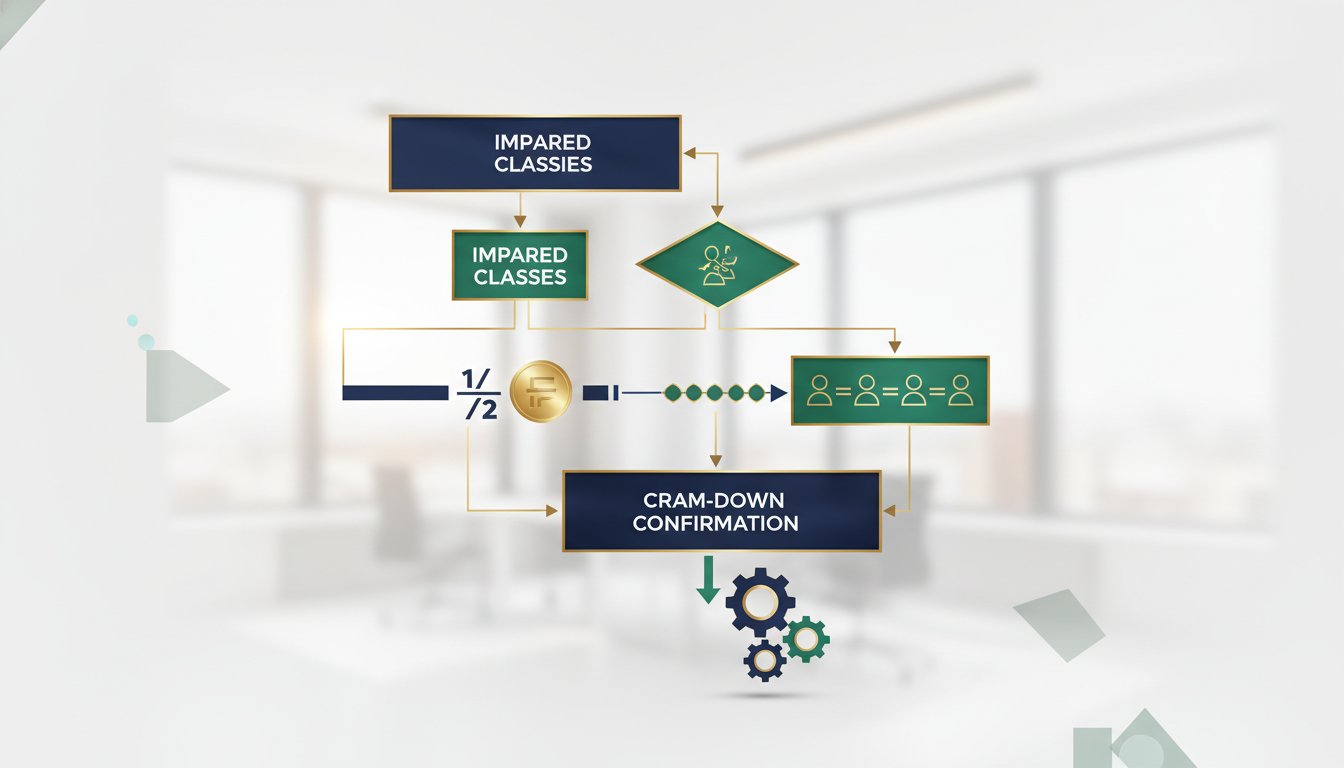
Why the 1-in-2 Threshold Matters in Subchapter V Cram-Down
The Subchapter V cram down voting threshold under 11 U.S.C. § 1126(c) requires two-thirds in dollar amount and one-half in number of impaired class votes for plan confirmation.1 This threshold—sometimes called the "1-in-2" test—is where I see practitioners make their most consequential errors in Subchapter V cases. The 1-in-2 threshold calculation error occurs when attorneys count all ballots in a class rather than limiting the count to impaired accepting votes only, triggering UST objections that can derail confirmation.
Subchapter V eliminates the 11 U.S.C. § 1129(a)(8) requirement that each impaired class accept the plan, making the 1-in-2 impaired class test under § 1129(a)(10) the critical gateway for cram-down confirmation.2 Without at least one impaired class voting to accept, the plan cannot be confirmed regardless of feasibility or good faith.
The threshold matters because it determines whether the debtor can force non-accepting classes into the plan. A miscalculation that inflates the denominator—counting abstentions or rejecting votes as part of the class total—can make an otherwise qualifying class appear to fall short. Conversely, excluding valid accepting votes from the numerator can cause the debtor to abandon a confirmable plan.
Consider a hypothetical Sub V debtor with $3M in revenue and three impaired classes. If Class 2 holds 12 creditors and 8 vote to accept, the 1-in-2 test requires at least 6 accepting votes. The debtor clears that threshold. But if the practitioner mistakenly counts all 12 creditors as the denominator and requires 6 accepting votes out of 12, the math still works. The error emerges when abstentions are counted as rejecting votes, shifting the denominator.
The 1-in-2 Threshold Calculation Error Explained
The error centers on how 11 U.S.C. § 1126(c) defines the denominator for the one-half-in-number test. The statute requires one-half in number of "the claims of such class that have been voted." This means only creditors who actually cast ballots count toward the denominator. Non-voting creditors are excluded entirely.1
| Counting Method | Denominator | Numerator | Result |
|---|---|---|---|
| Correct (per § 1126(c)) | Ballots cast only | Accepting votes | 8 of 10 = passes |
| Error 1: Include all creditors | All class members | Accepting votes | 8 of 12 = passes (still works here) |
| Error 2: Count abstentions as rejects | Ballots cast + abstentions as rejects | Accepting votes | 8 of 12 = passes (still works) |
| Error 3: Count non-voters as rejects | All class members counted as voting | Accepting votes | 8 of 12 = passes |
The error becomes dispositive when the accepting votes are close to the margin. Suppose a class has 15 creditors, 8 vote to accept, 2 vote to reject, and 5 do not vote. The correct denominator is 10 (8 + 2), requiring 5 accepting votes. The debtor clears with 8. But if the practitioner counts all 15 as the denominator, the requirement becomes 7.5 — still cleared. The real danger arises when the accepting votes are 6 of 15, with 4 rejects and 5 non-voters. Correct count: 6 of 10 passes. Incorrect count: 6 of 15 fails.
How the Error Affects Cram-Down Voting Outcomes
The practical effect of this error is binary: the debtor either has an accepting impaired class or does not. When the error causes the debtor to believe no class accepted, the case may convert to Chapter 7 unnecessarily, or the debtor may propose a less favorable plan.
In re Franco's Paving, LLC addressed whether failure to vote constitutes acceptance or rejection under § 1126(c).3 The court held that non-voting creditors are not counted in the denominator. This ruling directly impacts cram-down strategy because practitioners who assume non-voters count as rejects inflate the denominator and may incorrectly conclude the 1-in-2 test failed.
| Scenario | Accepting Votes | Rejecting Votes | Non-Voters | Correct Denominator | Correct Result | Erroneous Denominator | Erroneous Result |
|---|---|---|---|---|---|---|---|
| A | 5 | 3 | 4 | 8 | Pass (5 of 8) | 12 | Fail (5 of 12) |
| B | 4 | 2 | 6 | 6 | Pass (4 of 6) | 12 | Fail (4 of 12) |
| C | 7 | 5 | 0 | 12 | Pass (7 of 12) | 12 | Pass (7 of 12) |
Scenario A and B show where the error changes the outcome. Scenario C shows no difference because all creditors voted.
Common Factual Patterns That Trigger the Mistake
Three factual patterns consistently produce the 1-in-2 threshold calculation error in Subchapter V cases.
Pattern 1: Large classes with low participation. When a class contains 30+ creditors but only 8-10 vote, the temptation to count all class members as the denominator is strong. A practitioner reviewing a ballot report sees 30 creditors, 6 accepting votes, and instinctively concludes the class failed. The correct analysis: 6 of 8 voting creditors passes.
Pattern 2: Mixed impaired and unimpaired classes. When a class contains both impaired and unimpaired claims, practitioners sometimes apply the 1-in-2 test to the entire class rather than isolating the impaired claims. Unimpaired claims are deemed to accept under § 1126(f) and are not counted in the voting calculation.1
Pattern 3: Ballot challenges at the confirmation hearing. A creditor who did not vote may appear at confirmation and argue their claim should be counted as a rejection. The court must determine whether the failure to vote constitutes a deemed rejection — a question the Franco's Paving court answered in the negative.3
Why the Numerator and Denominator Must Be Separately Counted
The numerator and denominator serve different statutory functions and must be calculated independently. The numerator counts accepting votes. The denominator counts all votes cast. Combining them into a single ratio obscures whether the class actually accepted.
| Component | Definition | Source |
|---|---|---|
| Numerator | Number of accepting votes | Ballots marked "accept" |
| Denominator | Number of ballots cast | Accept + reject ballots only |
| Dollar test | Two-thirds of dollar amount of voted claims | Sum of accepting claim amounts ÷ sum of all voted claim amounts |
The dollar test under § 1126(c) requires two-thirds in amount of the voted claims. This test uses the same denominator — only voted claims — but applies a dollar-weighting. A class may pass the one-half-in-number test but fail the two-thirds-in-amount test if large creditors reject.
For a hypothetical class with 10 voting creditors holding $500,000 in claims: 6 creditors holding $200,000 accept, 4 holding $300,000 reject. The one-half test passes (6 of 10). The two-thirds test fails ($200,000 of $500,000 = 40%, below 66.7%1). Both numerator and denominator must be separately verified for each test.
Distinguishing Impaired from Unimpaired Classes in the Calculation
Section 1126(f) provides that unimpaired classes are deemed to accept the plan and do not vote.1 This means the 1-in-2 threshold calculation applies only to impaired classes that actually cast ballots.
The distinction matters because practitioners sometimes include unimpaired classes in the voting analysis, diluting the impaired class count. If a plan has 5 classes — 3 unimpaired and 2 impaired — only the 2 impaired classes are relevant for the § 1129(a)(10) test. The debtor needs at least one of those two impaired classes to accept.
| Class | Status | Votes Cast | Accepting | 1-in-2 Test Applied? |
|---|---|---|---|---|
| 1 | Unimpaired | N/A | Deemed accept | No |
| 2 | Impaired | 12 | 8 | Yes — passes |
| 3 | Impaired | 6 | 2 | Yes — fails |
| 4 | Unimpaired | N/A | Deemed accept | No |
| 5 | Impaired | 4 | 3 | Yes — passes |
The debtor needs only one accepting impaired class. Class 2 or Class 5 satisfies the requirement. Including unimpaired classes in the analysis would incorrectly suggest the debtor needs multiple accepting classes.
The Impact on Plan Confirmation and Feasibility
A miscalculated 1-in-2 threshold directly impacts plan confirmation by triggering UST objections. The UST reviews ballot tabulations as part of the confirmation package. When the tabulation shows an error, the UST files an objection that must be resolved before confirmation can proceed.4
The timing pressure is significant. Subchapter V cases target a 90-120 day timeline.4 A UST objection on voting threshold grounds can delay confirmation by 30-60 days while the court resolves the counting dispute. During that delay, the debtor continues operating under bankruptcy protection, accruing professional fees and trustee compensation.
Feasibility under § 1129(a)(11) requires the plan to be confirmable without likely liquidation or reorganization. If the voting threshold error is caught before confirmation, the debtor can re-ballot or seek a court determination on the correct count. If caught after confirmation, the plan may be subject to appeal or revocation.
Correcting the Error Before the Confirmation Hearing
Correcting the 1-in-2 threshold calculation error requires a systematic review of the ballot tabulation before filing the confirmation motion.
Step 1: Verify the class list. Confirm which classes are impaired and which are unimpaired. Unimpaired classes are deemed to accept and do not vote.
Step 2: Count only voted ballots. Exclude non-voting creditors from the denominator. For each impaired class, tally the number of ballots cast and the number marked accept.
Step 3: Apply both tests. Calculate the one-half-in-number test and the two-thirds-in-amount test separately. Document both calculations in the confirmation memorandum.
Step 4: Prepare for objections. Anticipate the UST's review by including a detailed ballot tabulation exhibit showing the numerator, denominator, and dollar amounts for each impaired class.
Step 5: File a pre-confirmation ballot report. Submit the ballot report 7-10 days before the confirmation hearing to give the UST and creditors time to review.
Your Next Step
Review your current Subchapter V ballot tabulation against the correct 1-in-2 threshold calculation. Pull the ballot report for each impaired class, verify the denominator includes only voted claims, and confirm at least one impaired class passes both the one-half-in-number and two-thirds-in-amount tests. If you find a discrepancy, file a corrected ballot report before the confirmation hearing. For a second review of your voting threshold analysis, contact [email protected].
Footnotes
-
https://www.law.cornell.edu/uscode/text/11/1126 ↩ ↩2 ↩3 ↩4 ↩5 ↩6
-
https://www.lowenstein.com/news-insights/publications/articles/subchapter-v-cramdown-plan-payments-true-up-to-actual-disposable-income-or-stay-true-to-projected-disposable-income ↩ ↩2 ↩3
-
https://www.fredlaw.com/the-restructuring-report/does-the-failure-to-vote-constitute-a-vote-to-reject-a-subchapter-v-plan ↩ ↩2 ↩3
-
https://www.abi.org/abi-journal/concerns-about-being-left-holding-the-bag-addressing-payment-of-subchapter-v-trustee ↩ ↩2 ↩3