MOR Filing Requirements and Deadlines Under Subchapter V
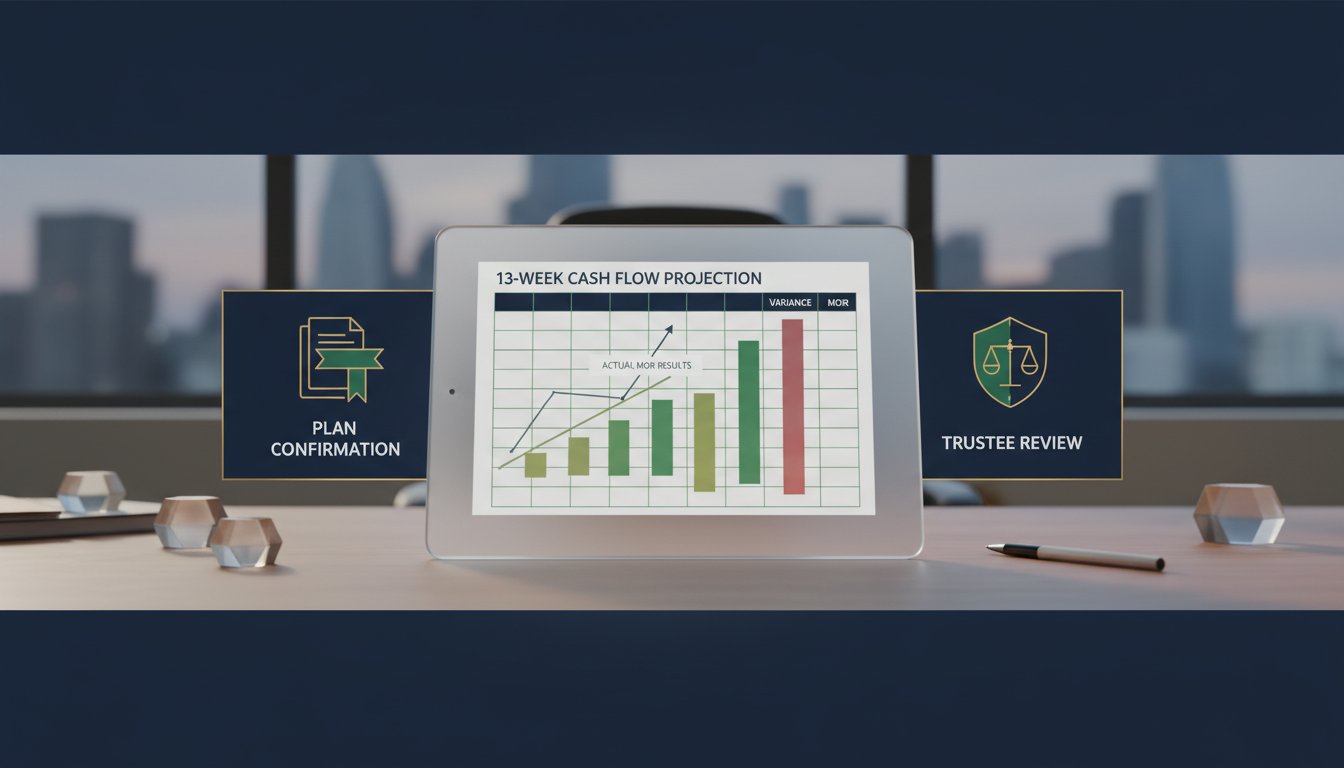
For a Subchapter V debtor, the path from filing to plan confirmation hinges on proving financial feasibility. Subchapter V variance analysis for plan confirmation is the critical, ongoing financial reconciliation that either builds trustee confidence or invites objections. It transforms the 13-week cash flow projection from a filing document into a living benchmark for performance. The U.S. Trustee’s office reviews each Monthly Operating Report (MOR) for material deviations from this forecast, and persistent, unexplained variances directly undermine the feasibility test required under 11 U.S.C. § 1191(a).
Subchapter V debtors must file Monthly Operating Reports (MORs) within 21 days of month-end per 11 U.S.C. section 1187 and Federal Rule of Bankruptcy Procedure 2015(a)1. This non-negotiable deadline applies to all months during the case, from the petition date through plan confirmation or conversion. The median Subchapter V case timeline is 8-14 months from filing to Plan Confirmation2, meaning a debtor typically files between 8 and 14 MORs. Late or missing MORs are a red flag for the U.S. Trustee (UST) and can lead to motions to dismiss or convert the case.
The cornerstone document is Official Form 425C, the Monthly Operating Report for Small Business Debtor. Its core function is variance reporting. Part 2 of Form 425C requires a line-by-line reconciliation of actual cash receipts and disbursements against the most recent 13-week cash flow forecast filed with the court. This is not a mere formality; it is the primary data source for the Subchapter V Trustee’s feasibility assessment. The trustee reviews these reconciliations to identify trends that threaten the debtor’s ability to fund its proposed plan.
UST oversight intensified in 2024-2025, with heightened scrutiny on variance explanations3. A budget variance exceeding 10-15% without documented justification frequently triggers Trustee objections3. The threshold is not a rigid rule but a practical benchmark signaling the need for clear, causal explanation. Variances within this range still require comment if they represent a negative trend or affect a critical line item like professional fees or debt service.
Effective variance management requires a structured framework. The following table outlines a standard approach for categorizing and addressing variances on Form 425C.
| Variance Category | Common Causes | Documentation Required for UST |
|---|---|---|
| Revenue Shortfall (>10%) | Lost customer, seasonal dip, pricing pressure. | Client loss notification, updated sales pipeline, revised market analysis. |
| Cost Overrun (>15%) | Unbudgeted repair, vendor price increase, professional fee accrual. | Vendor invoice, repair quote, counsel’s fee statement with task detail. |
| Timing Difference | Receipts/payments shifting between weeks within the month. | Bank statement highlighting deposit/payment dates vs. forecast. |
| One-Time Non-Recurring | Asset sale, insurance recovery, litigation settlement. | Copy of settlement agreement, closing statement, insurance claim approval. |
The goal is proactive communication. A narrative that simply states “sales were lower than expected” is insufficient. The explanation must connect the variance to a specific, verifiable event and, if negative, describe the debtor’s corrective action. For example, a hypothetical Sub V debtor with $3M revenue might report a 12% revenue shortfall due to the unexpected loss of its second-largest customer. The MOR narrative should attach the customer’s cancellation notice and summarize a plan to reallocate the sales team to three identified prospect accounts, with expected ramp-up over the next quarter.
Your Next Step
Audit the last three Monthly Operating Reports you filed for a Subchapter V client. Apply the 10-15% materiality threshold to each line item variance. For any variance exceeding that benchmark, assess whether the attached narrative explanation provides a specific, documentable cause and describes a management action. If the explanations are generic, those MORs represent a confirmation risk. Proactively preparing a supplemental variance analysis memo for the trustee can preempt an objection. For a template of this memo and a line-item checklist, email your request to [email protected].